
Myanmar has had a rough couple of centuries. British colonization in the 1800s kicked off a long cycle of exploitation. When World War Two started, nationalists in the country then known as Burma saw an opportunity to boot out the English, so they threw their support behind the Japanese. But the brutal Japanese occupation quickly disillusioned the Burmese, who decided the Allies were the lesser of two evils and turned against Japan. After the war a popular Burmese general, Aung San, became a national hero when he led Burma’s negotiations for independence from Britain, but he was assassinated by a rival politician in 1947, right after his party won a huge majority in Burma’s first elections.
Burma’s democracy didn’t have a chance to find its footing. In 1962 the Commander-in-Chief of the army, General Ne Win, overthrew the elected officials and established a socialist government that nationalized all private businesses and devastated the country’s economy. Ne Win outlawed other political parties, jailed those who defied him, and enriched himself while the country fell apart. Public anger boiled over in 1988 and pro-democracy demonstrators took to the streets. The government reacted by firing machine guns into the crowds. Over 3,000 people were killed, including women, children, and Buddhist monks.
A week after the slaughter, Aung San Suu Kyi – the daughter of assassinated hero Aung San – addressed a crowd of 500,000 people while standing underneath a portrait of her father. “This national crisis could in fact be called the second struggle for national independence,” she declared, infuriating the military dictatorship and cementing her status as the leading opposition figure.
The government, shaken by the uprising, pushed Ne Win into the background and announced a general election. True to their word, elections were held, but – when Aung San Suu Kyi’s party (the National League for Democracy) won over 80% of the parliamentary seats – the ruling Generals simply ignored the results. They tightened their authoritarian control even further, changed the name of the country from Burma to Myanmar, and placed Aung San Suu Kyi under house arrest, where she has been, off and on, for the past 20 years.
Many countries, including the United States and the European Union, have condemned Myanmar’s military dictatorship and imposed economic sanctions in an attempt to cut off the regime’s sources of income. The sanctions haven’t accomplished much, due in large part to the fact that countries like China and Thailand continue to do business with the Generals, allowing them to amass great wealth while the majority of the population wallows in poverty. Aung San Suu Kyi has asked the international community to impose even more severe economic sanctions, but if China and Thailand refuse to participate there’s little reason to believe it would make much difference.
Aung San Suu Kyi has also asked tourists to boycott the country. “Visit us later,” she said when the Myanmar government made a big tourism push in the 1990s. Some backpackers believe she was only referring to package tourists, who usually spend much more money and stay at expensive government-run hotels. But it’s not just about the money. Aung San Suu Kyi believes that when you visit the country you are implicitly condoning the regime.
Other Burmese democracy advocates – even some in Aung San Suu Kyi’s own party – disagree with her on this issue and encourage foreigners to visit. They think it’s important for the Burmese people to meet foreigners, hear about their lives, and exchange ideas. They believe that human rights abuses are much less likely to occur when foreigners are watching. And they argue that tourist dollars make a huge difference to many ordinary people who are struggling to survive, whereas the money the government receives from tourism is chump change next to the billions rolling in from China and Thailand.
My reasoning was pretty simple. I believe that isolating an oppressed country tends to make things worse, not better. Granted, I really wanted to visit Myanmar, so maybe I was just rationalizing a selfish decision. But where in modern times has isolating a country clearly produced a positive effect? Cuba? North Korea? I didn’t like the idea of ignoring Aung San Suu Kyi’s plea for a boycott, but ultimately I felt good about making the visit.
My plane made its final approach to Yangon (previously called Rangoon before the Generals changed the name) after sunset on Sunday. Surprisingly few lights shone up from the dark city. At customs I half expected some kind of KGB-style interrogation, but the bleary-eyed, bored officials just stamped my passport and waved me through.
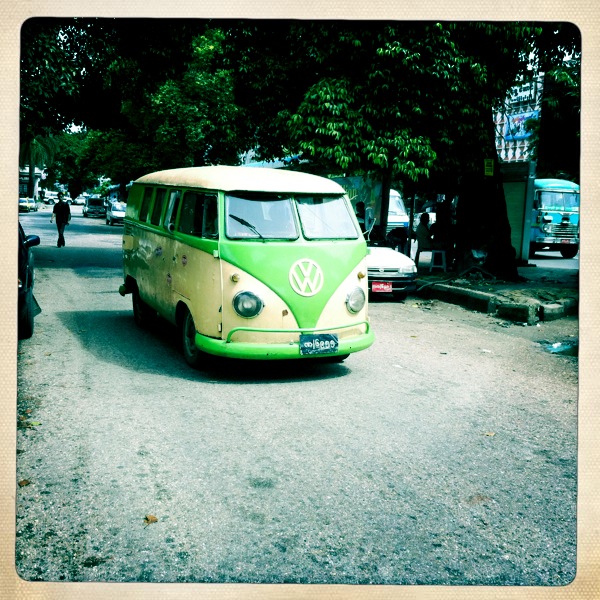
Fifteen minutes after my plane landed I stood on the street in front of the airport, besieged by men in longyis (kind of like a Burmese version of a Scottish kilt) offering taxis. One of the men led me to a beat-up, khaki-colored 1960s sedan. He and another man got in the front as I settled onto the tattered vinyl seat cover in the back.
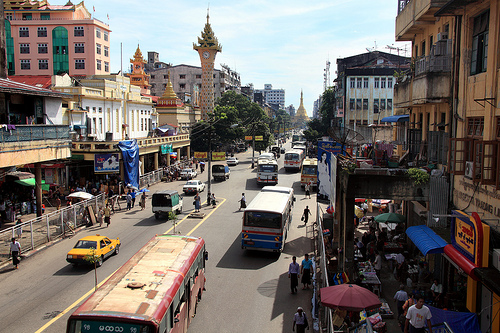
I felt like I’d gone back in time. Every car we passed looked like it had been built in the 60s or 70s. The houses and stores were either thatch and bamboo huts or buildings that must have been built before World War Two. Even the signs and billboards looked like they belonged to a different era. In Laos, which definitely qualifies as an impoverished country, I occasionally saw new cars and modern buildings in the larger cities, but everything revealed by our headlights as we drove to downtown Yangon was crumbling, molding, falling apart, or some combination of all three.
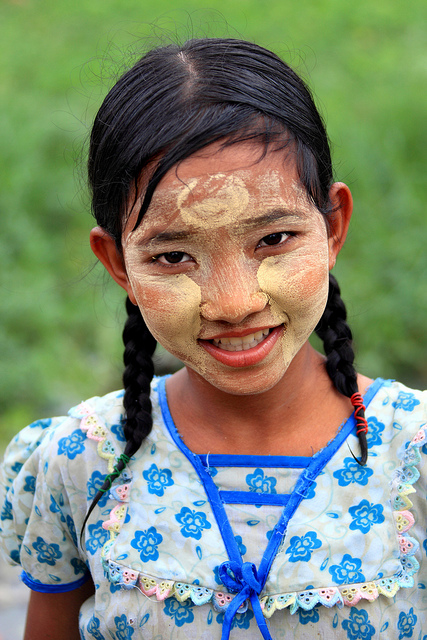
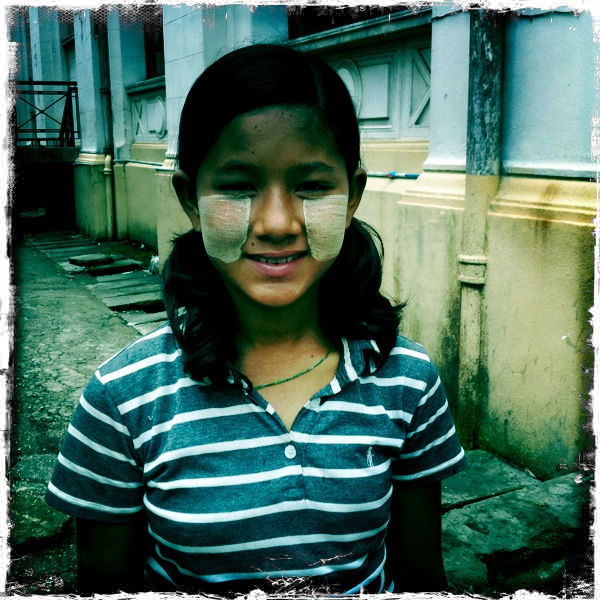
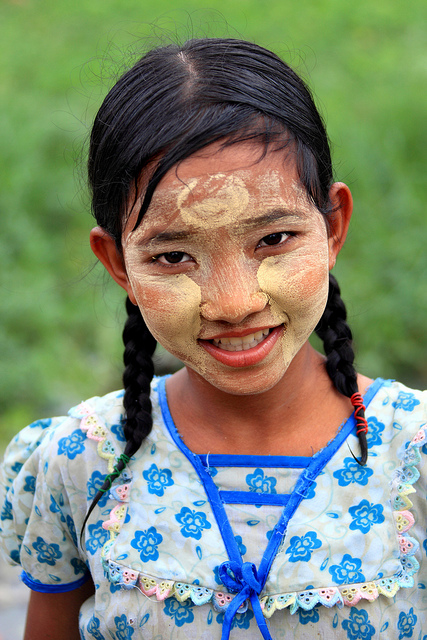
I checked into my hotel – a narrow, bland, seven-story concrete building with windowless rooms – and immediately went out to walk around. It was only 8:30 but most of the vendors were packing up for the night. In the shadowy streets I passed Indian men wearing turbans and longyis, Chinese workers drinking tea under flickering fluorescent lights, long-bearded Muslims spitting betel juice on the sidewalk, and pairs of Buddhist monks in brick-red robes walking arm-in-arm. Many women’s faces were covered with artistic patterns of yellow thanaka, a popular cosmetic and sunscreen made from the bark of local trees. Yangon was different. I felt a rush from the sense of being surrounded by so much that was unfamiliar.
The next morning I explored the city and didn’t see another tourist until I’d been out for two hours. Some of the locals later told me that tourism has dropped off significantly in the lead-up to the 11/7 elections. Businesses that rely on tourist dollars were bracing for a difficult dry spell.


“Elizabeth?” I asked. “That doesn’t sound very Burmese.”
“For tourists,” she explained. “More easy to say. My real name Khinsapel.”
Khinsapel pointed out the rest of her group sitting nearby, including her mother, her younger brother and sister, and two of her friends. “I be tour guide for you for Yangon,” she said.
Khinsapel looked like she was about 14. “Aren’t you too young to be a tour guide?” I asked.
“I seventeen… and a half,” she informed me, laughing when she added “and a half.” I didn’t want a tour guide but I did want to take some photos, so I hung out with Khinsapel’s crew for almost an hour. In between attempts to sell me postcards (just like Cambodia, “Ten for one dollar!”), her friends took over my camera and left me with about 20 blurry close-up shots of a nearby wall.


Khinsapel suggested we take the ferry across the Yangon River to Dalah, where she lived. She and her friend Kala would show me a couple of pagodas, then we’d stop by her house and on the way back we’d check out a local market. Sold!
The ferry was an experience by itself, full of monks, farmers pushing bicycles draped with half-unconscious chickens, groups of longyi-clad men with betel-stained teeth. Halfway across the river a strong rain began to fall and the passengers immediately contracted into an even denser mass in the center of the boat.
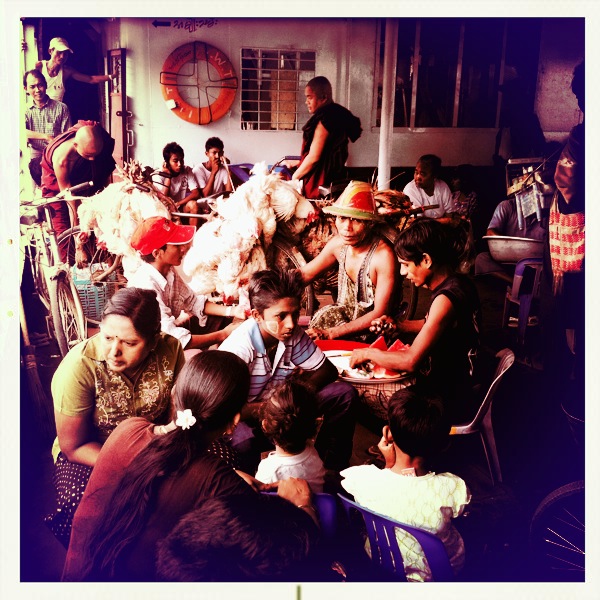


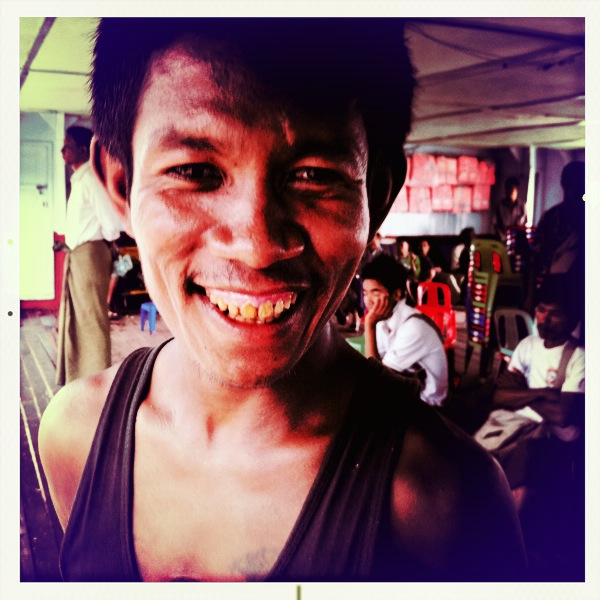


Khinsapel explained that Cycone Nargis, which hit Myanmar in May 2008, blew the roof off her house and damaged the walls. UNICEF, prohibited by the government from entering the country right after the disaster, was eventually allowed in, and according to Khinsapel helped a great deal by distributing rice and providing bamboo for reconstruction. Khinsapel’s family tried to repair their house, but she said the roof still leaks. The Myanmar government claims that 138,000 people died in the cyclone, but locals I spoke with said the toll was closer to 1.5 million.
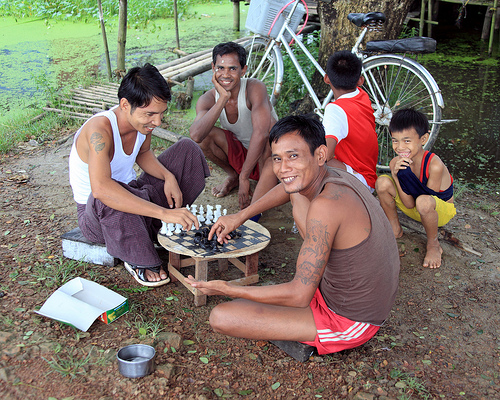
We arrived at Khisapel’s house, a tiny wood, thatch and bamboo hut held by stilts above a flooded field. Seven people – Khinsapel, her mother, two brothers, two sisters, an aunt, and a cousin – lived and slept in a space no larger than 8’ x 20’. We sat on the floor and talked for a while, then took our trishaw to the Dalah market.

Originally I planned to stay in Yangon for a few days, but locals told me a big festival had just started in Inle Lake and if I went there soon I could catch it. So I bought a bus ticket for the next day. The hotel manager who helped me book the ticket asked if I would be OK sharing a ride to the bus station with another tourist, and I gladly agreed.
At breakfast the next morning I met the other tourist – Elizabeth (coincidentally the same name Khinsapel used), a New Yorker in her 40s who was traveling alone. She had the skin of a long-time smoker and a voice that sounded eerily similar to Katharine Hepburn in her later years. And she liked to talk. Very little input was required from me to keep the conversation going.
Elizabeth, who seemed like a nice person, began to reveal herself as a Competitive Traveler. There are all different kinds of travelers, and the Competitive Traveler is one of the most common. Whether consciously or unconsciously, they treat travel as an opportunity to demonstrate superiority. Points are usually scored in one or more of the following areas: knowing more about a destination, having been to more places, traveling cheaper, or being more hardcore (which includes things like going off the beaten path, getting to know the locals, eating unusual local foods, and in general having experiences that seem less touristy and more authentic).
Just as snobs name-drop, Competitive Travelers place-drop – casually mentioning some obscure spot for no other reason than to ring up points for having been there. Elizabeth, for example, noticed something later that day that prompted her to say, “That reminds me of the time I was drinking Romanian wine with the locals in Losinj, just off the coast of Croatia.” No story followed, she just threw that out and moved on to the next topic.
Elizabeth and I were the only tourists on the 12-hour night bus to Inle Lake, so they sat us together. Two hours into the ride Elizabeth had already scored so many Competitive Traveler points off me that I think she felt it wasn’t sporting and decided to ease up a little bit. She established that I didn’t know anything about local food, I hadn’t read either of the two background books she considered most important (The River of Lost Footsteps and George Orwell’s Burmese Days), I didn’t know why the Myanmar generals moved the capital from Yangon to Nay Pyi Taw, and, unlike her, I was hightailing it all the way to Inle Lake instead of stopping for a couple of days in Kalaw (a small mountain town with good trekking opportunities).
I even made the mistake of revealing my own lack of perception. “I’m not sure what I was expecting,” I told Elizabeth, “but the Big Brother stuff here isn’t as overt as I thought it would be. If I didn’t know when I got here that this place is ruled by an oppressive military dictatorship, I don’t think I would have figured it out from just a couple of days walking around Yangon.”
“Oh I would have,” Elizabeth assured me. “The signs are everywhere. I’ve traveled enough that I know how to read people.” She went on to point out some legitimately good clues to the true nature of the government: no ATMs, painfully slow and sporadic Internet connections with many sites blocked, no Western stores, decaying infrastructure. Still, I wouldn’t have been sharp enough to put it all together. I’d already seen all those things in other Southeast Asian countries. Siem Reap, Cambodia’s biggest tourist destination, didn’t have ATMs until four years ago. Vietnam blocks many Web sites, including Facebook, which isn’t blocked in Myanmar. The internet connections in Laos are slow and sporadic, and I didn’t see any Western stores there either. And the infrastructures of both Cambodia and Laos are in similar states of disrepair.
At about midnight Elizabeth and I nodded off into a kind of half-sleep, the best we could do while sitting up on a bus that constantly pitched and weaved as it navigated washed-out roads covered more by mud than pavement. The next thing we knew someone shouted “Kalaw!” at Elizabeth as the bus lurched to a halt. Disoriented and groggy, she packed up her things, said goodbye, and disappeared into the 4am dark.
My turn came an hour later when the bus dropped me off at Shwenyaung junction, 14 kilometers north of Nyaungshwe, the small town most backpackers stay in while visiting Inle Lake. Someone pointed me towards the front porch of a rickety restaurant. Another tourist sat on one of the restaurant’s low wooden stools, and I assumed we were waiting there until we had enough people to make it worthwhile for a pick-up truck to drive to Nyaungshwe. A passing bus spit out another tourist just as the first sign of light appeared on the horizon, and three was the magic number – the pick-up driver loaded us up and headed towards Inle Lake.


I'm so glad to read your Myanmar adventure. It's like a new world opened to my eyes. Politics aside, Myanmar is like a world back in time where few tourists venture to, people are simple, honest and not influenced by tourism industry. Thanks for the story and I'll keep checking back your blog to read more.
Don
LikeLike
Your hair grew back very quickly.
LikeLike
Dan-Brown style cliffhanger! Well done!
LikeLike