

“Yes, not normal,” he confirmed. Someone later told us the last time that area had rain in November was almost twenty years ago. The wet weather followed us all the way to Ranthambore, where we checked into our hotel as the rain continued to fall. Someone at the front desk of our hotel said that the rain had forced the cancellation of all safaris into the park that day. Marie and I weren’t scheduled to go on safari until the next day, but if the rain continued we might be out of luck.
Earlier we’d asked Raju if our Ranthambore hotel would be nice. “Oh, yes, five-star hotel,” he gushed. When we checked into our hotel room Marie pointed to a splatter of some kind of dark liquid covering our TV’s remote control and questioned whether that met five-star standards. Remote aside, I couldn’t get the TV to work so I started fiddling around with the plug. Suddenly a painful shock raced up my arm.
“I just electrocuted myself,” I told Marie, my arm still tingling. “Does that happen at five-star hotels?”
Leaving the room seemed safer, so when the rain momentarily let up we went out to see the town. Fifteen minutes later we realized there just wasn’t much to see and turned around. Back at the hotel one of the safari operators said he thought the roads would be too muddy to use tomorrow and we began to be seriously concerned that we wouldn’t have a chance to see the park at all, let alone spot a wild tiger.
Later in our hotel room the phone rang. “Hello,” said a heavily-accented voice.
“Uh, yes?” I said.
“How are you?” asked the voice.
“I’m fine, thanks. Who is this?”
The voice ignored my question. “What time will you eat dinner tonight?” I said I didn’t know. “Can we bring you anything?”
“No thanks,” I answered. Then whoever it was just hung up. We found out later it was someone from the hotel checking in on us. Marie and I tried to wrap our heads around this. “India,” we agreed.
All night we heard rain beating on a corrugated metal roof outside our window. We went to the hotel lobby early the next morning, as instructed, to find out if the park would be open. “Park still closed,” we were told. Later in the morning the rain began to trail off and we started to hope the park might open that afternoon. A group of Danish tourists pressed the safari operator to let them go to the park regardless of the weather.
“You must assume all risk,” the safari operator told the Danish tourists. “The roads are terrible, far too muddy. It is very dangerous!”
Marie and I discussed our options. We thought about pressing the safari operator to let us go out that afternoon, too, but it was easy to picture our jeep stuck in the mud as tigers licked their chops nearby. We had the flexibility to stick around until about noon the next day, so we decided we wouldn’t push it that afternoon but we’d insist on going the next morning, regardless of the conditions.
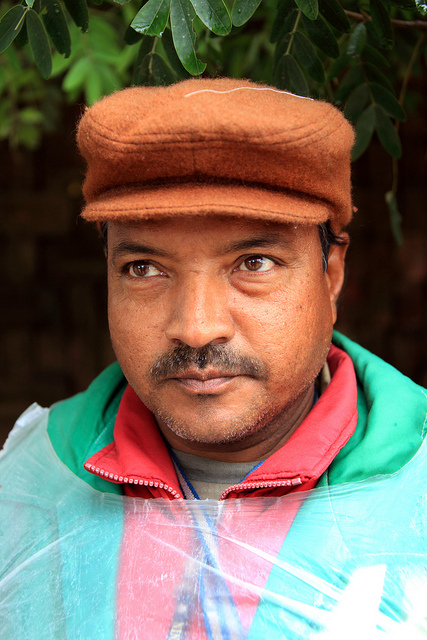
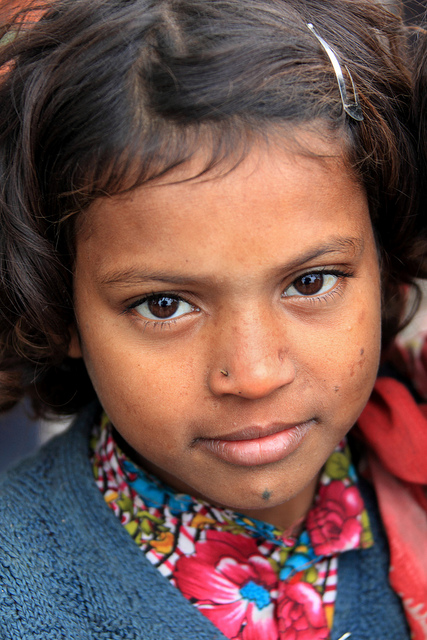
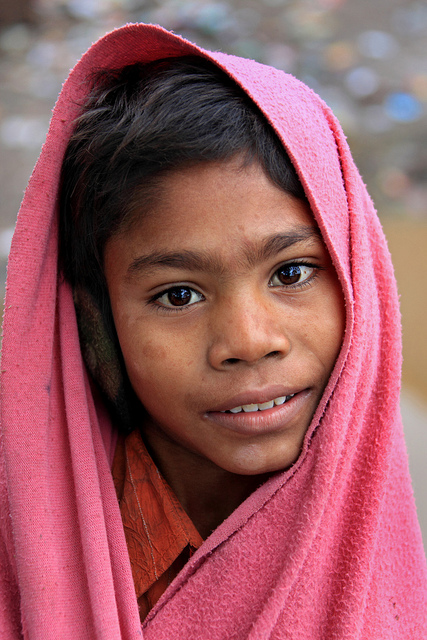
Tired of our hotel room, we ventured out into the muddy streets again and I managed to get a few portraits.
Ten minutes later the same safari operator knocked on our door. “You go now,” he said.
“Go where?” we asked.
“Safari. Your jeep here.”
And sure enough, our jeep was waiting for us out front. Marie and I tried to reconcile this fact with what we’d heard earlier from the safari operator. “India,” we concluded. Thirty minutes later we were at the entrance to the park. Cold and desperately missing the fleece jacket I’d accidentally left in a Mumbai cab, I bought an embarrassingly touristy jacket from one of the vendors who swarmed us when we stopped at the entry gate. Marie sarcastically admired the orange tiger paw sewn into the back.
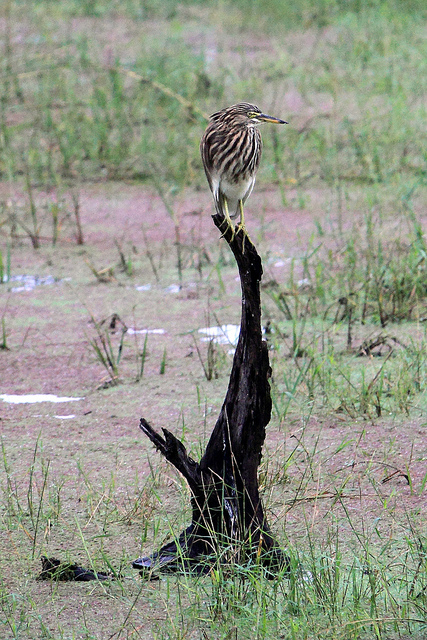
We rode in an open-top jeep called a canter, large enough to fit 20 people, and spent two or three hours cruising around the park. Early-on our guide managed our expectations by saying that because of the weather we had almost no chance of spotting a tiger. Marie and I were just happy to be inside the park, and we did see monkeys, deer, and a variety of birds – peacocks, egrets, herons, plum-headed parakeets, among others.



Two other men sat with Raju, but they didn’t respond when we asked for their names and they seemed to have had a lot to drink. Raju pointed out the mutton, already cooked and sitting in a silver pot connected to a gas stove. When Raju lit the stove, Marie noticed that she was sitting right next to the gas tank and didn’t rule out the possibility that it might explode at any moment.
It began to rain again, slowly flooding the muddy ground beneath us and extinguishing the fire. Raju passed me a plate full of mutton, big chunks of meat still clinging to the bone. “Do you have a knife?” I asked.
“My friend,” Raju boomed. “This is not a restaurant!”
So Marie and I, passing the single plate back and forth, picked up the mutton with our hands and dug in. It actually tasted pretty good, but the conditions around us deteriorated rapidly. Our feet were soaked, and a hole in the tent unleashed a stream of water on my back. We were cold and wet, but we finished the mutton. Or so we thought.
“You only tested it!” Raju complained when we thanked him for the great dinner and handed back our plate. We told him the food was excellent and that we genuinely thought we’d eaten all the meat, but clearly our effort disappointed him and I felt bad.


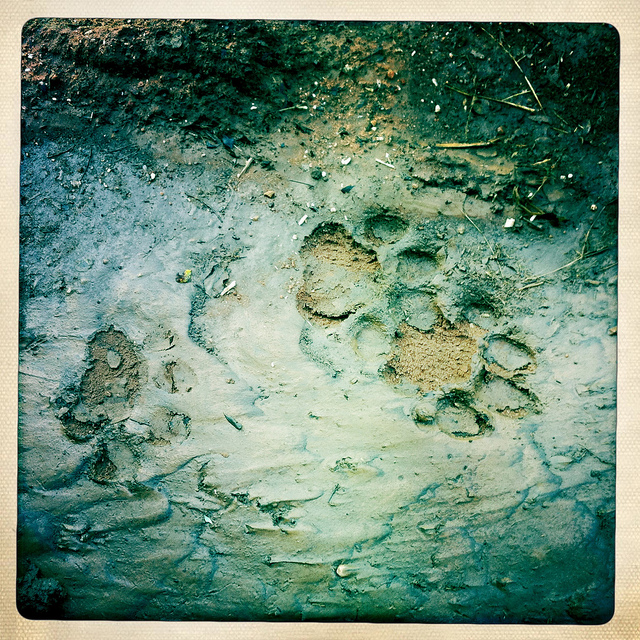
At one point, as we were headed up to higher ground, our guide told the driver to stop. Even in the fast-moving gypsy he’d somehow managed to spot a few faint tiger tracks in mud at the side of the road. We stopped to listen, and our guide heard monkey alarm cries in the distance. “These tracks are fresh,” the guide said. “And now I think the tiger is about 500 meters in that direction.” He pointed towards the sound of the monkeys, back where we’d been earlier.
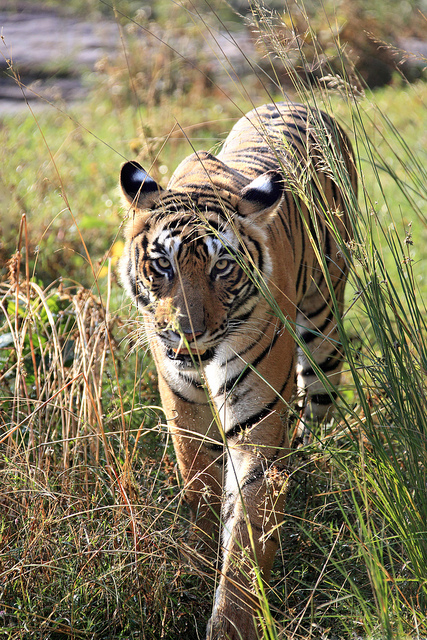
I remember holding on tight as we splashed through a creek and sped around a bend, when suddenly I realized that through the jeep’s windshield I was looking at a tiger. A very close tiger! The jeep skidded to a stop and we all leaped to our feet. The tiger trotted towards us, forcing our driver to put the jeep in reverse to maintain some distance. Even so, the tiger – a four-year old female, we found out later – approached within fifteen feet of our jeep several times and could have closed the distance with ease. For ten minutes she followed us, forcing our driver into an impressive display of driving in reverse.


Rob, what an incredible story. I've been to India twice and to two tiger preserves but never even saw a pawprint! What an amazing sight! I'm envious, but happy to live vicariously through your experience 🙂
LikeLike
That is incredible. I can't believe there was something good about India! It sounds awful from what's happened up until this point. Those tigers are absolutely beautiful. I'm jealous!!! Good job. And Raju sounds like quite the character…
LikeLike