
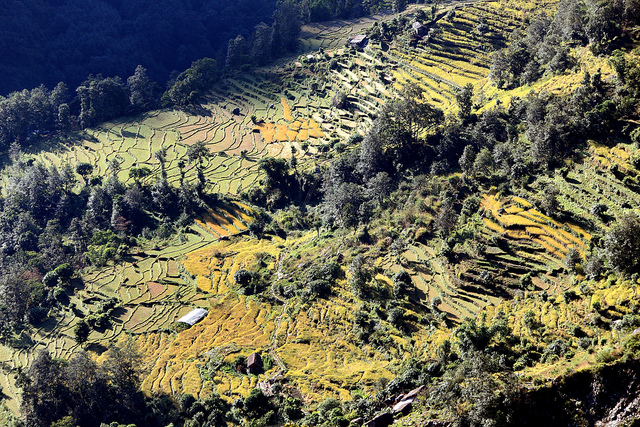
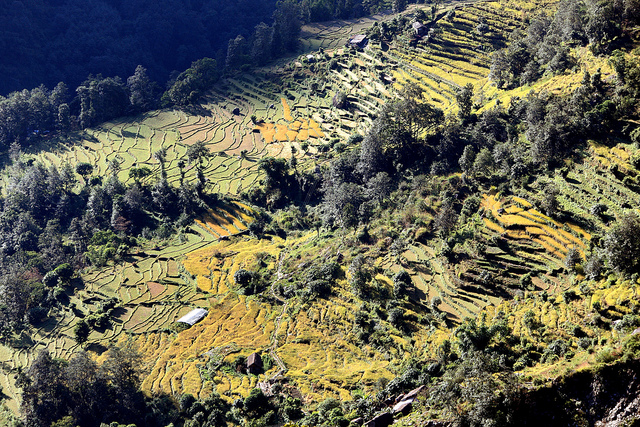
Day 1 – Nayapul (1100m) to Kimche (2250m)
It was mid-morning before a minivan arrived to take us from Pokhara to the starting point of our 10-day trek. By then we’d gathered the rest of the travelers in our group – six total including me, supported by a guide, an assistant guide, a cook, and seven porters. It turned out to be an interesting cast of characters.
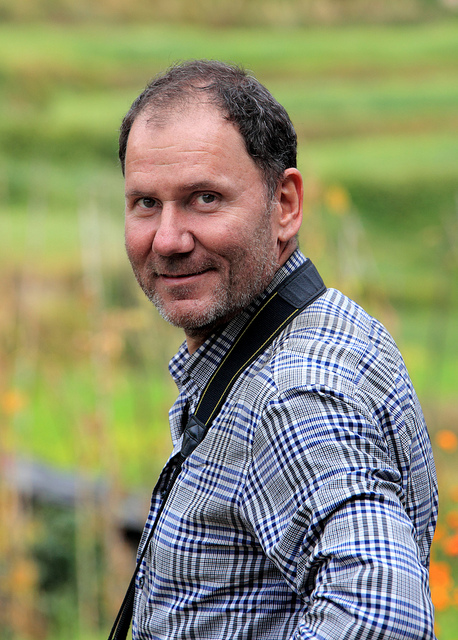
I’d already met Elie, 56, from Belgium. Elie said he makes a habit of taking a month-long trip every year, always concentrating on just one country. Over the course of our first few days, Elie listed all the countries he’s visited and pronounced each one to be amazing (“Indonesia… Have you been there? Amazing country. Sri Lanka is an amazing country. Costa Rica, also amazing. Jamaica… You know it? Amazing.”).



We reached Nayapul in the early afternoon and were soon on our way, finally relying on our feet instead of wheels. We tourists carried only a backpack with things we planned to use that day. Everything else – sleeping bags, tents, food, extra clothes – went on the backs of the porters, who each carried a massive load, using the typical Nepalese method of wrapping a support strap around their forehead. I find it really curious that almost every country in Asia seems to have its own unique way of carrying heavy loads. In Nepal, they use the forehead strap. In Cambodia, they balance the load on their head. In Vietnam, they divide the load in two and suspend it from a wooden beam that rests on their shoulder.


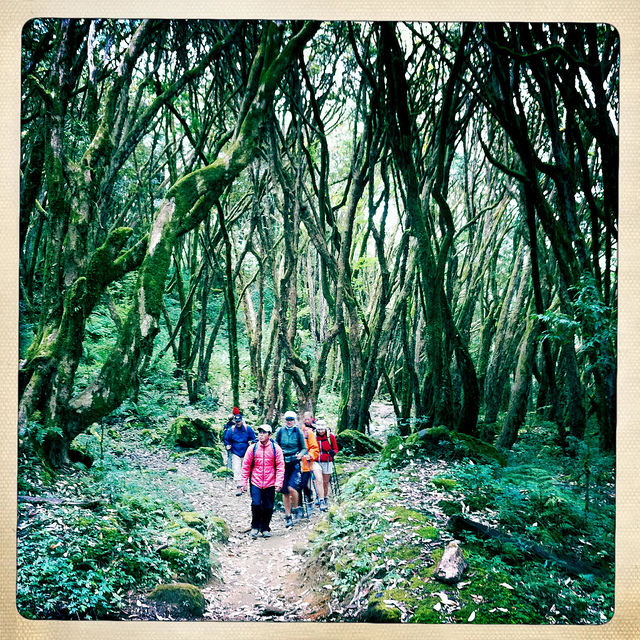
We woke early, had breakfast, and hit the trail. Sweat soaked my t-shirt when I hiked uphill in the sun, but the temperature dropped as the altitude increased. Clouds rolled in that afternoon and we had to bundle up to stay warm. We passed through a whole range of different scenery – fields of terraced agriculture, moss-covered forests, rocky waterfalls.
Elie joined us as the conversation turned to movies. “You’re from Belgium,” I said to Elie, “so I have to ask you about Jean-Claude Van Damme. Do you have a poster of him on your wall?”
“No, I do not like him,” said Elie. “I have not watched his movies.”
“Not even Bloodsport?” Say it isn’t so!
We hadn’t yet reached the less-traveled trails and we frequently passed tourists headed back down to Nayapul. In the mid-afternoon we arrived at the guest house in Tadapani where we would spend one more night in a room before switching to tents for the rest of the trek. Thanks to our relatively modern accommodations I was able to take a hot shower – the last one I would have for the rest of the trek. In the late afternoon a group of people celebrating the final day of Tihal played music and started dancing outside of our guest house.

“Can you do it?”
Ursus laughed. “First I have to practice.” I must have looked a little skeptical, so Ursus reassured me by pointing out that the book was written by Dr. Frank Kinslow, a professor at a prestigious American university. He referred to the back of the book. “Everglades University, in Florida. You know this one?”
“I can’t say that I do.”
After dinner another group of Tihal dancers descended upon us. Kids danced for money and adults joined in after downing a few drinks, usually a glass filled halfway with rum and the rest of the way with hot water. They started with traditional Nepalese music and built up to Shakira’s Waka Waka and, oddly enough, Aqua’s Barbie Girl.
As usual I woke up before dawn for photos and had some luck this time – a beautiful orange sunrise over the mountains.


As I mentioned in a previous post, people who live outside the United States tend to know a lot more about our country than we do about theirs. Tato was no exception. Since the start of the trek he’d been comparing Brazil and the U.S., and the U.S. always came up short. As we walked that afternoon his commentary turned to music. “Rappers in the United States are always showing off,” Tato observed. “For them the money and jewelry are the most important thing. In Brazil it is different. In Brazil rappers always give back to the community.”
After dinner that night Tato identified more of my country’s flaws. “Why in the United States do you not have a national I.D. card? That is stupid, man. If someone crosses the border, how do you know if they are a citizen? In Brazil, we have a national I.D. card and this is much better.”
Elie overheard this. “You do not have a national I.D. card?” he asked in amazement. “We also have this in Belgium. Much easier.”
Tato was just warming up. He switched themes. “In the United States, you have too many freedoms,” he explained. “If you want to vote for a Nazi, you can vote for a Nazi. I think this is terrible. And you are free to not vote at all if you do not want to vote. In Brazil, everyone is required to vote, and this is much better.”
That’s when I snapped. Tato’s point about too many freedoms didn’t particularly bother me, it was just the tipping point. Each time he bashed the U.S. it raised my blood pressure a tiny bit. And instead of letting Tato know early-on that I didn’t appreciate his one-sided perspective, I let the pressure build. It’s a good example of a bad habit that sometimes causes me to go from overly reserved to overly worked up. I spoke loudly, quickly, and condescendingly, first lecturing in a pedantic tone, then sarcastically asking Tato if he was the authority who should decide exactly which freedoms to restrict and which to allow. Before he could answer I ran through the basics of the U.S. constitution and our ability to amend it if and when we decide a change is needed. I told Tato that if we wanted voting to be mandatory, we could make it mandatory. But we don’t. “So your issue isn’t with our political system,” I told him. “It’s with the decisions we’ve made as a people. Are you saying you know better than we do?”
Tato looked a little startled. “I guess you’re not OK with people criticizing your country,” he said.
Later Tato very graciously (and unnecessarily) apologized, which gave me a chance to explain. “People love to hate the U.S.,” I told him, “so I hear lots of criticism and I’m OK with that. I reacted the way I did because for three days every comment you made about the United States was negative, and every comment you made about Brazil was positive. Instead of pointing that out, I let myself get overly annoyed.” I suggested that Tato would have better conversations with people he’s just met if he doesn’t lead off with an uninterrupted flow of criticism. Tato understood where I was coming from and we happily avoided political conversations for the rest of the trek.
That night was our first in tents. The temperature continued to drop as we climbed, and to stay warm I had to wear my jacket in my sleeping bag. In the middle of the night I got up to go to the bathroom and, despite the cold, stood staring at the sky for a long time. At that altitude, away from all cities and competing lights, the stars were free to put on a real show.


Ursus reminds me of Uncle Jim because he has 2 houses and his girlfriend lives in the one in Brazil…
And by the way, Shawn's hat in the group photo from day 2 is HYSTERICAL!!! Haha! I love it.
LikeLike