
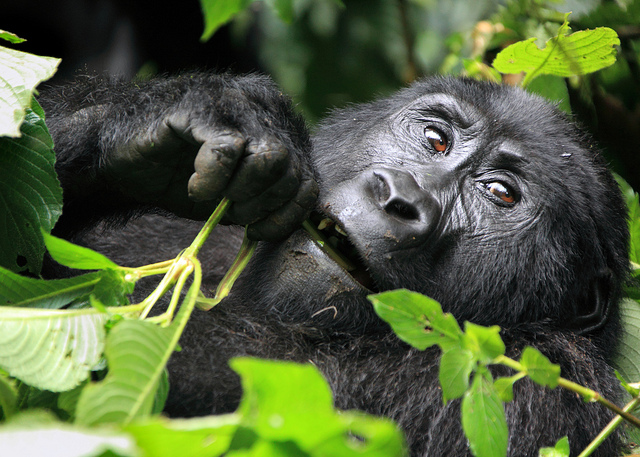
I woke before dawn, too excited to sleep. If all went well I’d be kicking off the New Year by high-fiving mountain gorillas. Breakfast was mercifully quick, and Andrew and I left Kisoro just as the first sign of light appeared in the sky. We needed to be at Bwindi’s Ruhija sector by 8:00am. If we were late I wouldn’t be able to join the gorilla tracking group and my $500 permit would be forfeited.
The scenery between Kisoro and Bwindi Impenetrable National Park was beautiful – rugged hills covered with small farms – but the roads were unmarked, unpaved and very rough. I assumed Andrew knew where we were headed, but I had to discard that assumption when he stopped to ask a small boy for directions. The boy told us we’d taken a wrong turn and needed to go back. But the dirt road, a single lane cut into the side of a steep hill, was too narrow for us to change directions. We had to drive another ten minutes before Andrew could find enough space to turn around. The day’s first wave of panic swept over me: what if I’m too late?
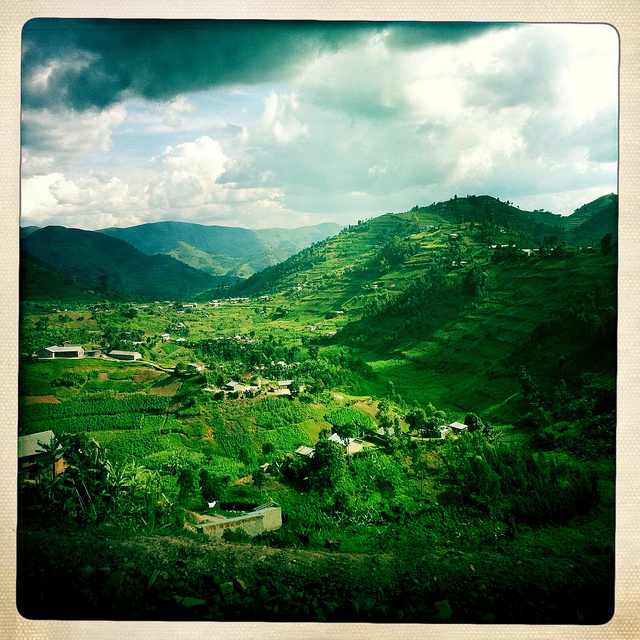

After thirty stressful minutes Andrew began to see landmarks he recognized. It was a close call but we made it to the Ruhija trekking center right at 8:00am. While checking in I suffered a second wave of panic when the clerk asked for my passport. Andrew had assured me that I only needed to bring hiking shoes, a rain jacket, and a lot of water. “I didn’t bring my passport,” I said sheepishly. The clerk complained to Andrew.
“You didn’t bring your passport?” Andrew said, flashing me a “What were you thinking?” look.
I told the clerk I knew all my passport information – number, date of issue, date of expiration, etc. The clerk relaxed. Given that I could provide all the data he needed to complete his paperwork, he let it slide that I couldn’t produce the passport itself. But yikes… A second close call.
There were five other tourists in my tracking group – a 50-year-old Dutch guy, a young couple from Canada, and a young couple from Brazil. Everyone looked fit. Our guide gave us a little background and explained the rules. We’d be tracking the Nshongi group (sometimes spelled Shongi). It was a relatively new group, habituated only two years ago. It had 23 members, including three silverbacks.
The guide told us that it could take us anywhere from one to four hours of hiking to find the gorillas. If we did find them we would only be allowed to stay in contact for one hour. And we had to be prepared for the chance we might not be able to find them at all. That possibility triggered a third wave of panic. Can you imagine how frustrating it would be to come up empty after getting so close? The guide tried to make us feel better: “If we do not find the gorillas,” he said, “we will refund half of your permit fee.” Some consolation!
The guide recommended that we each hire a porter. Really? A porter? Each of us only carried a daypack with water, a sack lunch, a camera, and a rain jacket. And we’d be out for 10 hours at the most. The Brazilian couple, who had tracked a different gorilla group the day before, strongly agreed with the guide. “The porters don’t just carry your backpack,” the Brazilian woman told us. “They push and pull you up the hills. They do everything.” I have to admit they almost scared me into it. But I came to my senses. The Canadian couple and I took a pass on the porters.
I did, however, decide to use a walking stick – something I’d sneered at in the past. It always seemed like more of a hassle than it was worth. But wow, on that particular hike it made a huge difference to have that walking stick. It was helpful almost constantly, and it saved me from a major wipe-out more than once.
The people who named Bwindi added the word “Impenetrable” for a reason. It may be hyperbole – visitors are, after all, able to penetrate the park – but I’d never hiked through more hostile terrain. I thought trekking in the jungles of the Bokeo Nature Reserve in Laos and Gunung Leuser National Park in Sumatra had been difficult, but Bwindi was worse.
Our hike started on a friendly, level trail. But very quickly all signs of flat ground disappeared and we began to climb. On treks I prefer to be at the very front or the very back, and at first I walked in the back with our guide. Every now and then the guide used his mobile phone to check in with the trackers who had gone out before us. So far the trackers hadn’t located the gorillas. I began to worry.

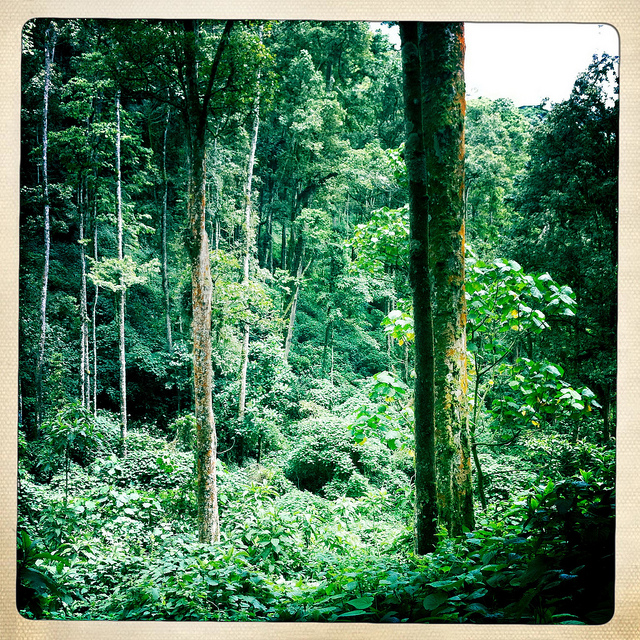

If we weren’t slogging through the mud we were trying our best to avoid stumbling over an unstable lattice of roots and plants that had been mashed down on the trail. Without my walking stick I would have been on my butt more than my feet. The humidity drained us. Whenever the sun broke through the clouds the jungle began to steam. Ants burrowed under our clothes and bit us.
The steepest inclines were usually covered with mud and we found it almost impossible to avoid slipping, especially going downhill. Walking on top of the vegetation wasn’t much better – the rope-like tendrils tripped us, thorns cut us, and every now and then one of our legs slid through a hole in the net-like carpet of vegetation and plunged us up to our waist in a tangle of green. Even the guides and trackers fell. I found myself wondering how much worse it would be if it started raining.
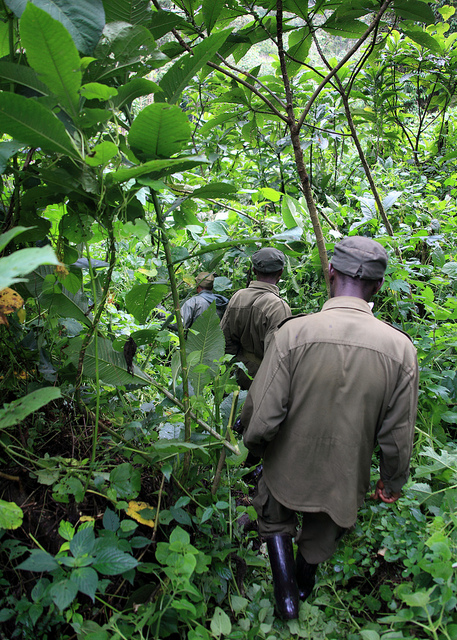
A park ranger carrying an AK-47 hiked at the front of our group. Deciding it would be a good idea to make friends with someone armed with an automatic weapon, I caught up to him and started a conversation. His name was Abrahim (which he pronounced ah-brah-HEEM), and he said he’d been working in the park for 11 years. I asked about his AK-47. “Have you ever had to shoot it?”
“Yes, but only into the air,” he said. “To frighten elephants.”

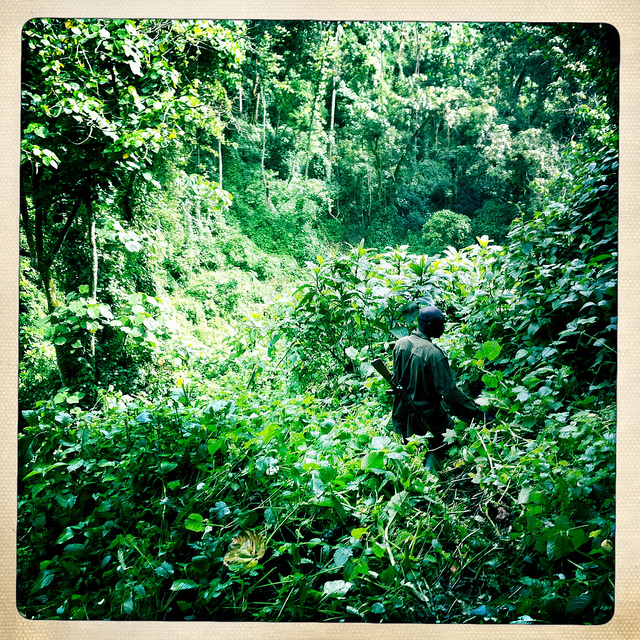
At the top of a hill Abrahim pointed to a steep downward slope in front of us. “The gorillas are there,” he said.
“But the guide just told me the trackers haven’t found the gorillas yet.”
Abrahim smiled. “I have been working in this park for many years.”
And he was right. Thirty minutes later the trackers told the guide that they’d located the gorillas, right where Abrahim said they’d be. By that time we were very near. To close the remaining distance we had to hack our own trail through the brush.
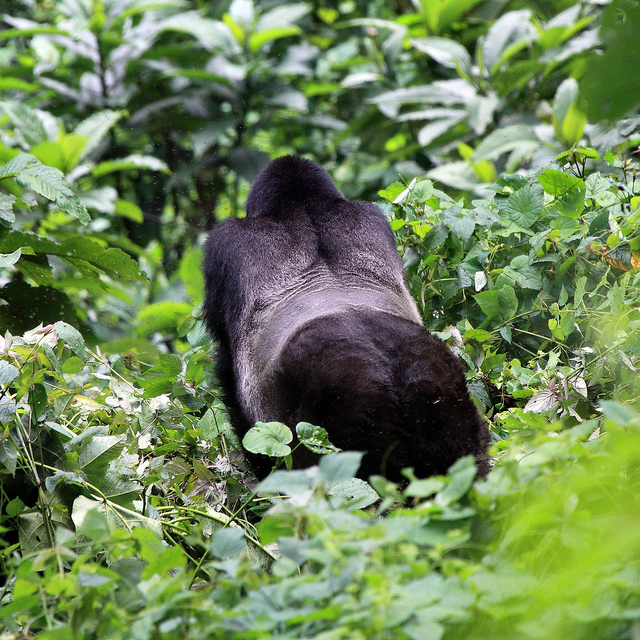


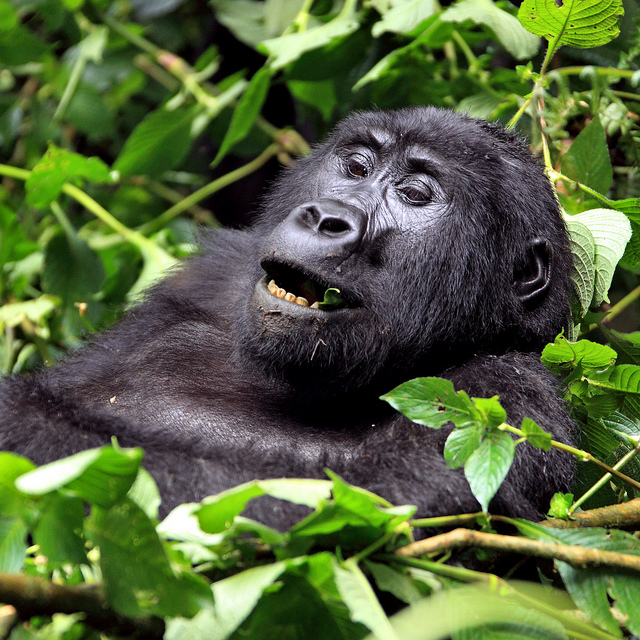
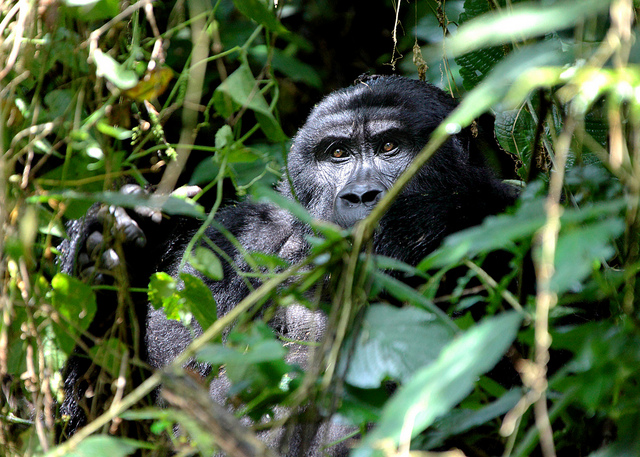
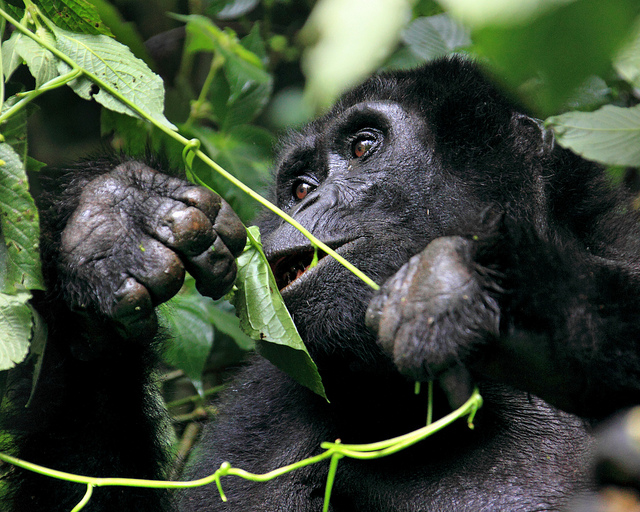
For the first time on the trip I let my camera stress me out. It’s common for travelers to claim that taking photos diminishes the quality of an experience, that if you’re taking photos you’re less there. But for me, taking photos usually enhances my experience. It helps me connect with the moment.
This time, though, my camera worked against me. Our time with the gorillas was so limited that I put too much pressure on myself to get good shots. And getting good shots was extremely difficult under the circumstances. The gorillas were almost always hidden by plants and trees. They moved fast. It was too dark, thanks to the jungle canopy. And my fellow trekkers wanted to get good photos, too. If I stood in their way I felt guilty; if they stood in my way (as the Dutch guy always managed to do) I felt frustrated.
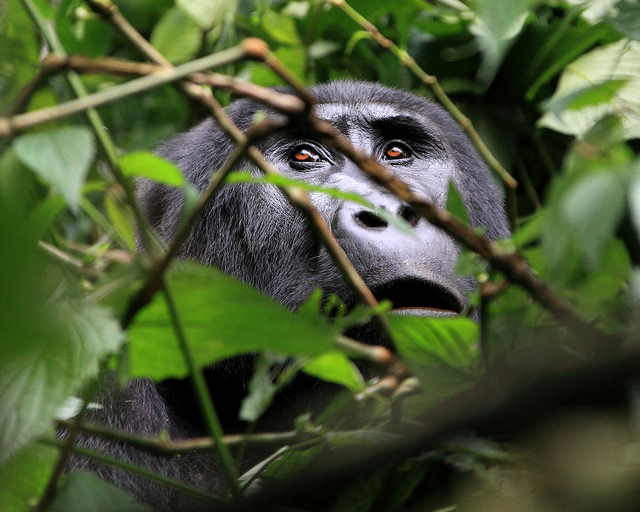


We wished the silverback a Happy New Year and reluctantly left the group. As the post-gorilla high wore off our thoughts began turning to the long haul in front of us. It had taken us almost four hours to find the gorillas and we’d need just as much time to hike back. We battled our way through the vegetation for an hour, stopped to eat our sack lunches, and then hit the trail again. Eventually we noticed a line of dark clouds on the horizon. “Is that heading our way?” I wondered.
A tapping sound in the trees above us answered my question. We had less than a minute to put on our rain jackets before the sky released a tremendous downpour. It rained for an hour. Steep slopes that had already been muddy were transformed into jungle slip-and-slides. None of us stayed upright for very long. Our pants and boots quickly turned an identical shade of reddish-brown.
When we finally arrived back at the entry gate my tank might not have been completely empty, but there’s no question that the red warning light was blinking. I was exhausted. An experience like that is far more rewarding when you have to earn it, and we definitely earned it. My legs were sore for the next three days. It was a New Year’s Day I’ll never forget.
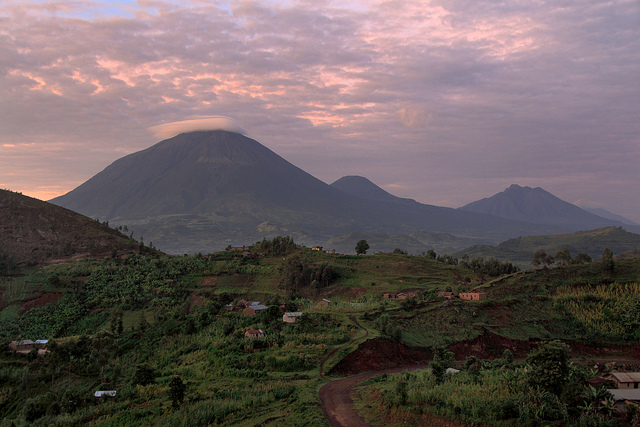
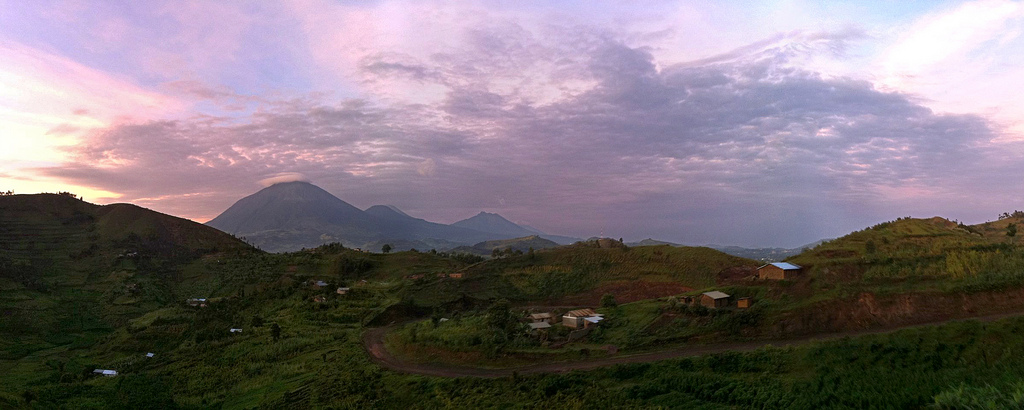
The next morning Andrew and I left Kisoro before dawn. Clouds had blocked my view of the Virunga volcanoes when we first arrived, but that morning the massive volcanic cones were clearly visible. As we drove up through the hills surrounding the town I had a chance to photograph that amazing landscape in the ever-changing morning light.

 endlessloopphotography.com
One thought on “Bwindi Impenetrable National Park, Uganda”