

Day 1 – Marangu Entrance Gate (1,970m) to Mandara Hut (2,700m)
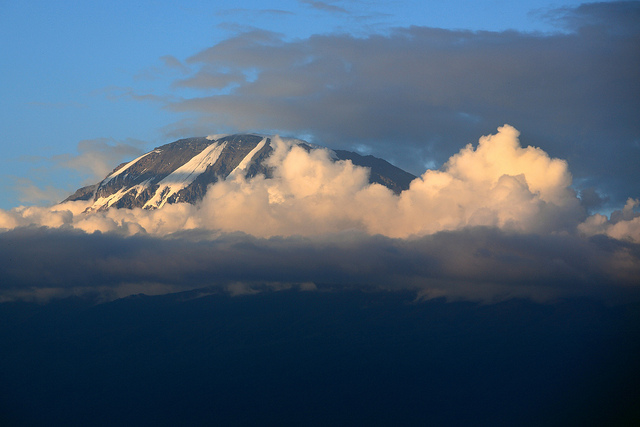
At dawn on the first morning of my Kilimanjaro trek I stood on the roof of my hotel and watched the first hint of pale orange sunlight reflect off the snow surrounding Uhuru Peak. I couldn’t see them, but I knew long lines of frozen, weary hikers were at that moment slowly working their way towards the summit. I tried to imagine what it would feel like to stand there at the top, the roof of the entire continent, with a hundred miles of raw African landscape unfolding in every direction.
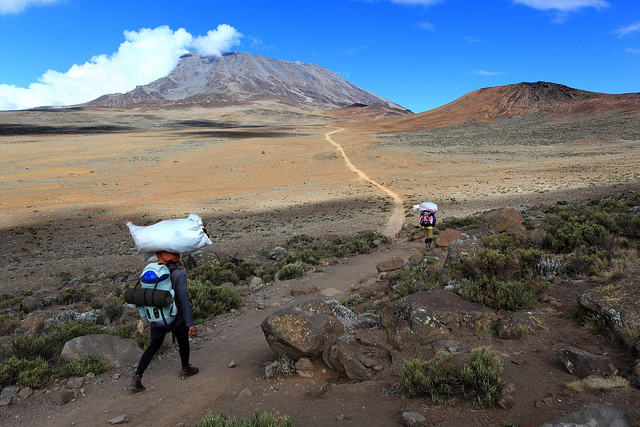
Happy God met me at my hotel and introduced our cook, Rama. The three of us rode from Moshi to Kilimanjaro National Park’s Marangu entrance gate in a beat-up taxi, its tinny speakers cranking out hip-hop music so loud that it drowned out any attempt at conversation. My backpack sat wedged between my feet, loaded only with the items I might need during the day: water, a rain poncho, my camera, a fleece jacket, and sunscreen. At Marangu I shook hands with Simon, the lanky, tireless porter who would walk twice as fast as me while shouldering his own backpack and balancing on his head a duffel bag containing the rest of my gear.
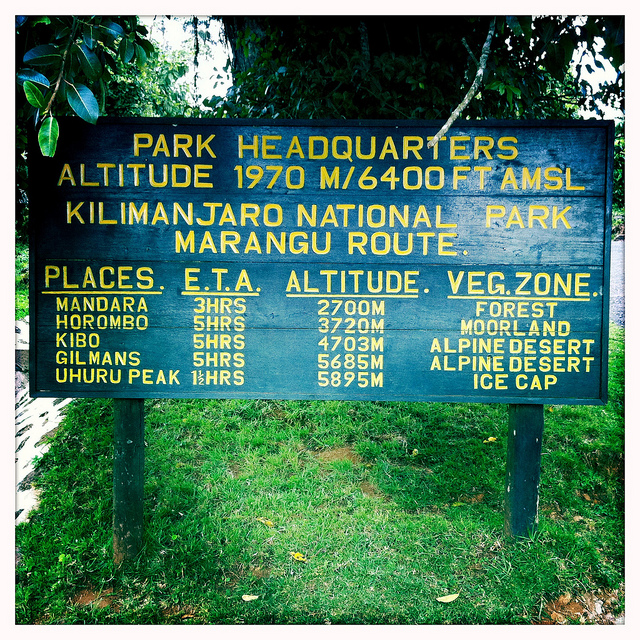
Ten minutes later I fell flat on my face. I hadn’t tied my rented hiking boots above my ankles, which left too much shoelace hanging loose. One of the laces swung over and wrapped around the opposite boot, pinning my legs together as effectively as a cowboy’s lasso and sending me sprawling on the rocky trail. Rama turned to check on me. “No problem!” I said casually, hoping to reassure him that this embarrassing clumsiness wasn’t a sign of things to come (while privately acknowledging that many more wipeouts almost inevitably awaited me).
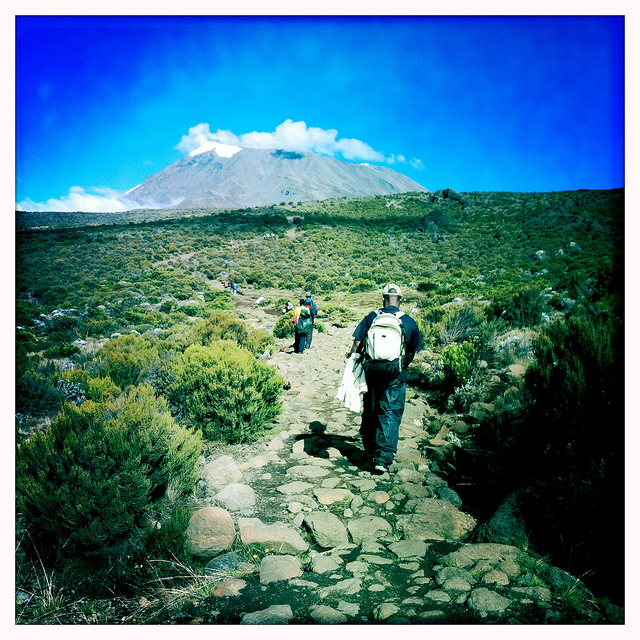
The first day of the Marangu route was an easy three-hour walk in the pleasant shade of leafy green trees. For entertainment we had baboons and monkeys swinging in the branches above us. In what may have been an attempt to compensate for my rough start, I picked up the pace and passed Rama. “Pole, pole,” Rama scolded, invoking the sacred mantra of all Kilimanjaro guides. Slowly, slowly.
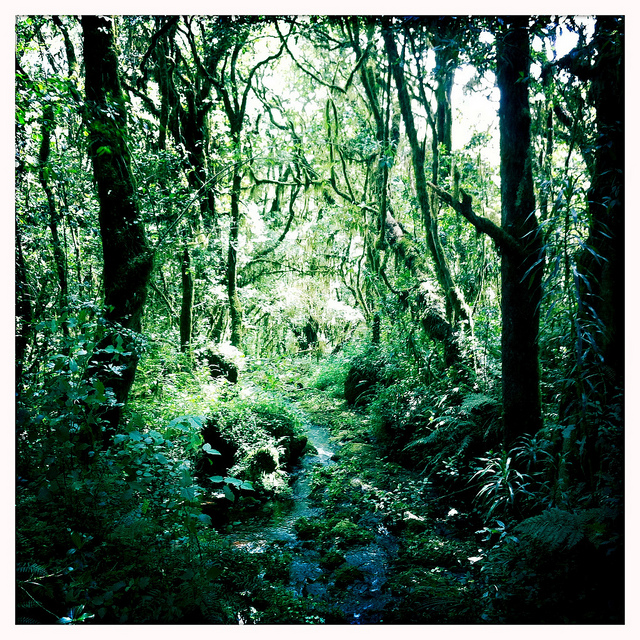
That afternoon Happy God and I hiked up a short side trail to see the Maundi crater. Happy God told me that he and his girlfriend had one son, a six-year-old named Jifty. “Do you think you and your girlfriend will get married?” I asked.
“No,” said Happy God, suddenly looking as if he’d been punched in the stomach.
I changed the subject. “What kind of music do you like?” My fingers were crossed in the hope that his answer would not include any of Southeast Asia’s unholy trinity (Scorpions, Shakira, and The Eagle’s Hotel California).
“I like reggae music,” Happy God told me. “Do you know Bob Marley?” I breathed a sigh of relief. Definitely a step up from Scorpions.
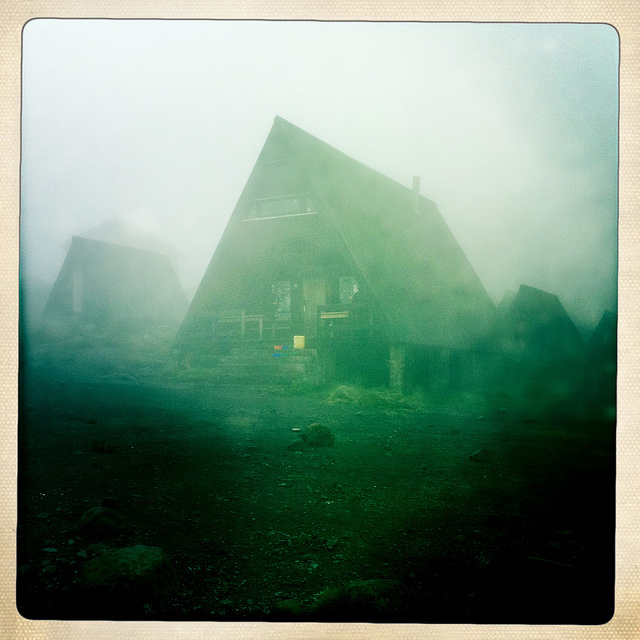
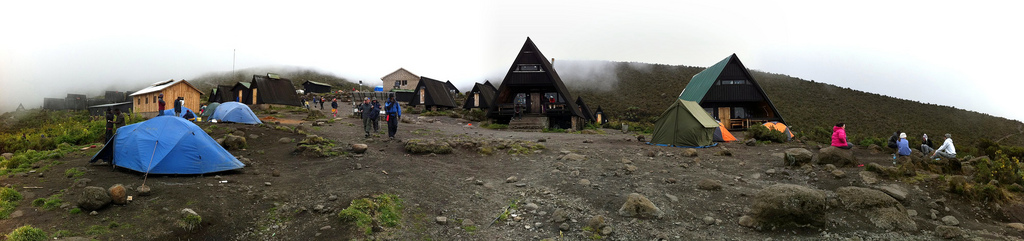
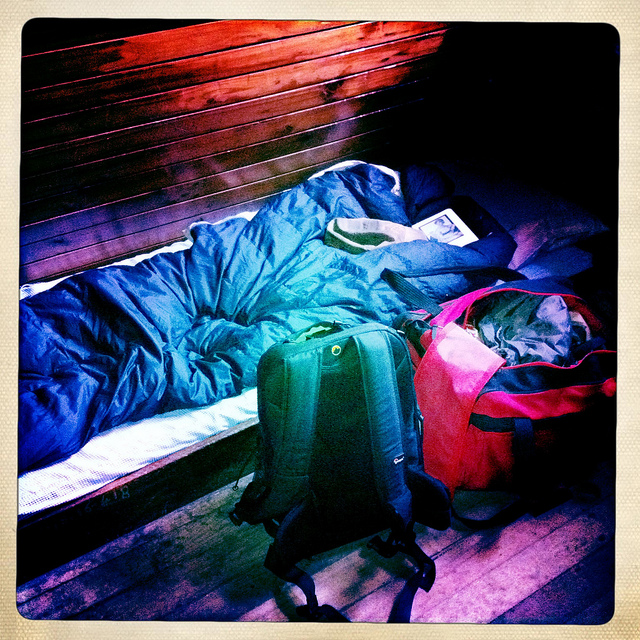
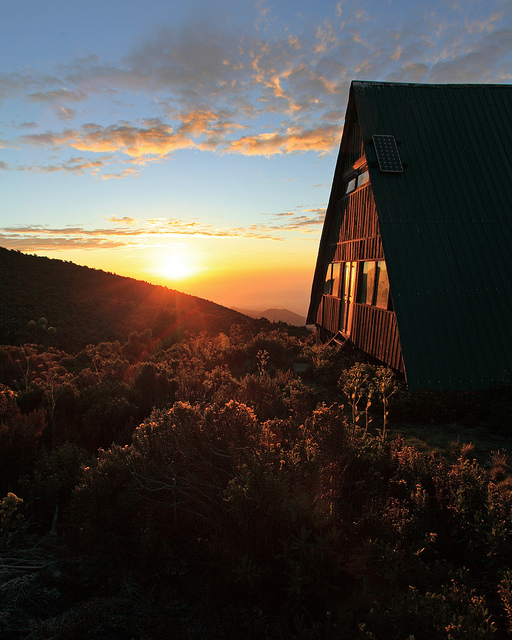
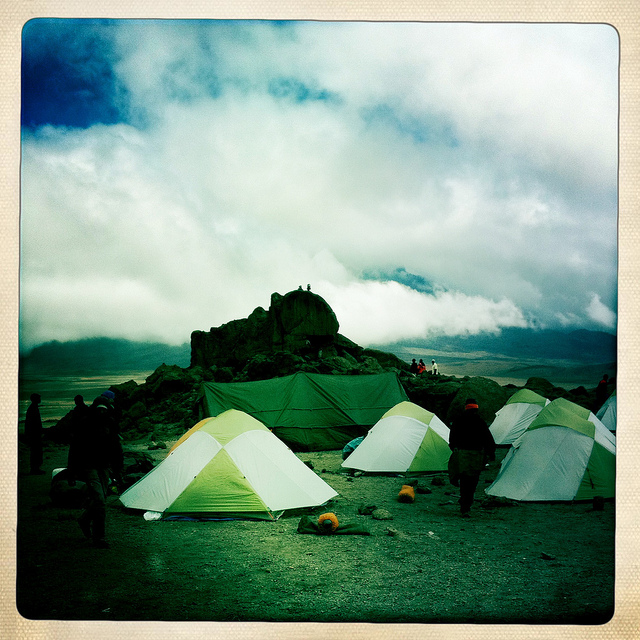
That night I shared an A-frame hut with three Japanese tourists. Each of us had a small bunk with a foam mattress to use under our sleeping bag. There were about 40 trekkers at Mandara and we all ate dinner together in a wooden dining hall that resembled a primitive ski lodge. Most of us had very similar food: soup as an appetizer; a main course of rice, potatoes or noodles with mixed vegetables and meat; and fruit for dessert. When dinner ended there was nothing to do but return to our huts and call it a night. I was asleep by 8pm.
I woke to a guttural snorting sound that rose and fell in an unnatural rhythm. A quick scan of the still-dark hut identified the older Japanese man in the bunk directly across from me as the culprit. Irrevocably awake, I stared at the ceiling until pale morning light began to seep through our only window.
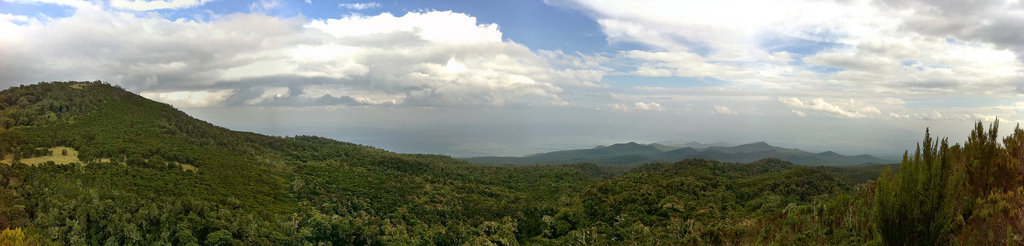
After breakfast I packed up and hit the trail again, this time with Happy God taking the lead. The landscape shifted from thick forest to the lean scrub brush of an alpine desert. An hour into our hike we passed four porters carrying a middle-aged Western man on an army-green canvas stretcher. “Sick or injured?” I asked Happy God.
“Injured, I think.”
We walked fast and reached the Horombo hut in four hours instead of the usual five. Happy God, who never seemed particularly enthusiastic about “pole, pole,” chose that moment to throw out a surprising curveball. “Do you want to hike to Uhuru Peak tomorrow afternoon?” he asked.
Most trekkers on the Marangu route arrive at Kibo, the final hut, around noon on Day Three. At Kibo they try to sleep for a few hours, and then at about midnight they make their summit attempt. It usually takes six or seven hours to reach Uhuru Peak, so – if all goes well – they arrive at the summit just as the sun is coming up. Many people even push that itinerary back by a full day so they can spend an extra night acclimatizing at Horombo.
Happy God, on the other hand, was proposing that we leave early the next morning and make our summit attempt without even stopping at Kibo. I didn’t know what to say. Was he really so confident I could handle that much altitude gain in such a short time? Wasn’t the summit usually blanketed by view-killing clouds in the afternoon? Was Happy God just in a hurry to get back to Moshi? “I’ve heard that seeing the sun rise from Uhuru Peak is amazing,” I told Happy God. “So I’d rather just stick with the normal schedule.”
“OK, no problem,” he said.
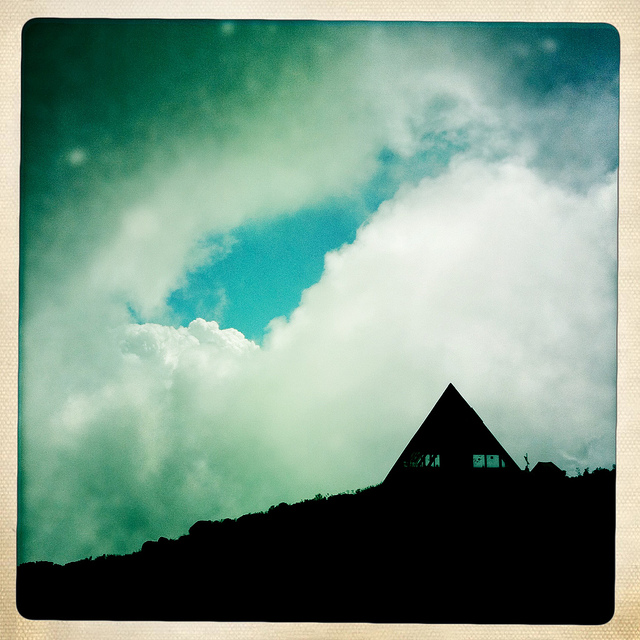
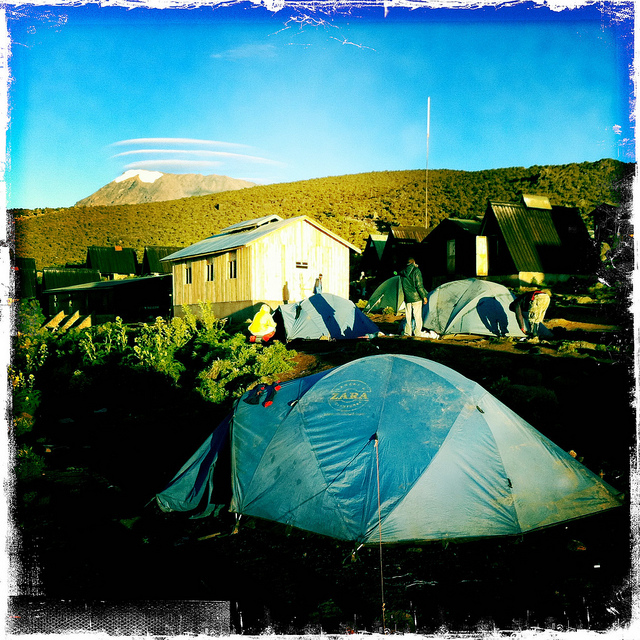
We found Horombo Hut hidden in a thick fog. I heard the camp’s activity before I could see any of the A-frame huts through the cold, dirty-white mist.
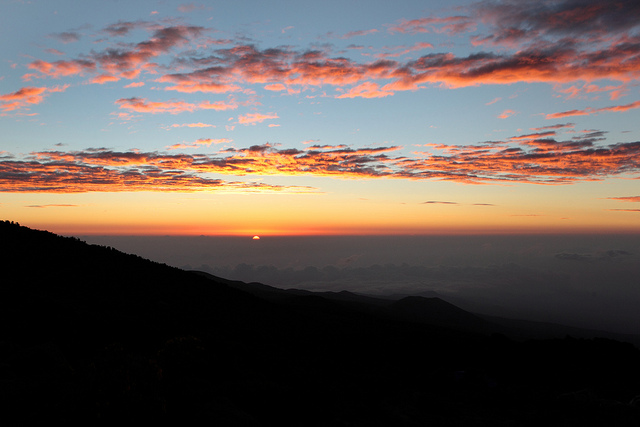
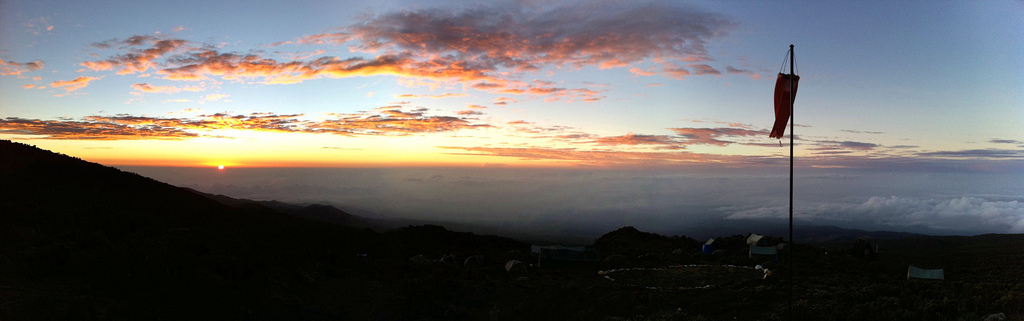
Up early, camera in hand, I watched the sun rise over the Tanzanian plains east and south of Kilimanjaro. A few rows of puffy morning clouds raced through a complete tour of the color spectrum, beginning with icy purple-blue and peaking with fiery red.
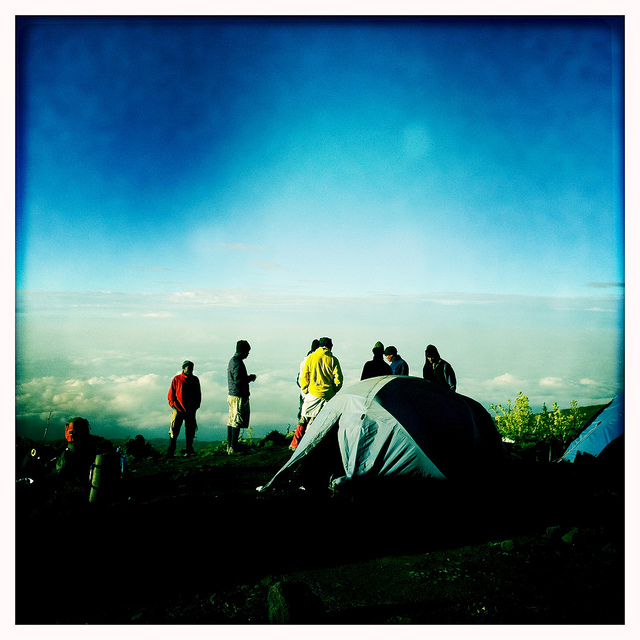
“Sometimes people get a headache and they stop,” said Happy God, not bothering to mask a hint of disdain.
At Horombo we’d seen a big group of Australian college students on their way up. Happy God and I guessed there were about 40 of them. “How many of those Australians do you think will make it to Uhuru Peak?” I asked. I didn’t expect Happy God to give me a real answer. Most of the locals I’d met in Asia and Africa were very reluctant to make predictions about the future. Almost every time I asked someone if they thought it would rain, for example, the answer was some version of, “Maybe yes, maybe no.” Others would shake their head silently, finding it odd that I would ask a question so inherently unanswerable.
But I should have known better than to make assumptions about someone named Happy God. “I think 26 of the Australians will make it,” he declared brashly. We weren’t able to check on the accuracy of his unusually precise prediction, but I bet he was very close.
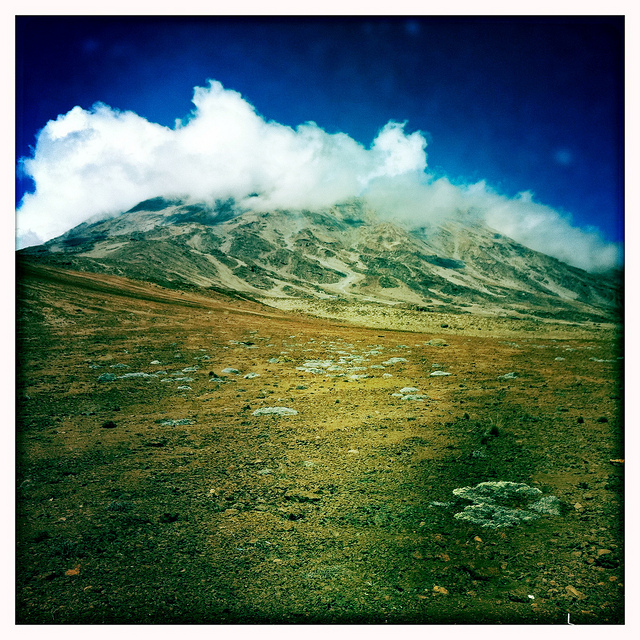
About an hour away from Kibo we entered the gently-sloping gap between Kilimanjaro’s two peaks, Uhuru and the slightly lower Hans Meyer. It was a barren moonscape of dust and volcanic rocks, unimaginatively called “the Saddle” because of the shape of its profile. I’m drawn to extreme landscapes and I found myself comparing the Saddle to the desolate beauty of Death Valley in California.
The hut’s manager assigned me to a room filled with bunk beds and a long dining table. Across the hall I saw a group of Americans who had just returned from Uhuru Peak. “How was it?” I asked one of them, a tall man with a runner’s build.
“The worst 11 hours of my life,” he said. “The altitude… I had total muscle failure. Never felt anything like it before.” Great! Just the pep talk I needed.
Clouds moved in after lunch and the temperature plummeted. On the way to the outhouse I noticed small white pellets bouncing off the rocks in front of me. Within the space of 15 minutes we’d shifted from a pleasantly sunny afternoon right into a hailstorm.
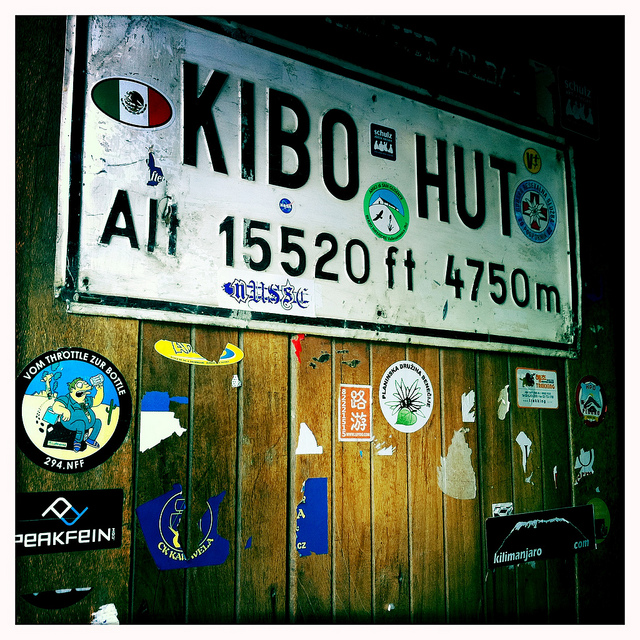
At 10pm guides came in to wake up the groups who planned to start before midnight. Simon brought me tea and cookies at 11pm, and Happy God stopped by to check on my gear. Taking Happy God’s advice, I cocooned my torso in six layers – a short-sleeved T-shirt, a long-sleeved T-shirt, a long-sleeved button-down shirt, a fleece jacket, a down jacket, and a rain jacket. On my legs I wore thermal underwear, trekking pants, and waterproof rain pants. In my backpack I carried only water, my camera, and some food.
Happy God gave me the thumbs-up. It was just before midnight. “Ready?” he asked.
“Ready as I’ll ever be.” I knew I wouldn’t simply quit, so an injury or some kind of debilitating altitude sickness were my only concerns. Considering my history of clumsy wipeouts, an injury while hiking in the dark didn’t seem out of the question. And I’d never been higher than 5,000m before. I had no idea how my body would react to the thin air at almost 6,000m.
Happy God told me to think about the hike from Kibo to Uhuru Peak in two stages. The first and most difficult stage is the steep ascent from Kibo to Gilman’s Point, which usually takes five hours. From Gilman’s Point the trail to the summit is relatively easy, a gentle slope that runs along the rim of Kilimanjaro’s main crater and only takes about 90 minutes.
We left Kibo hut and began our climb. A bright gibbous moon rose above Gilman’s Point like a lighthouse, dramatically backlighting the ominous rock wall in front of us. Tiny white dots from the headlamps of the hikers who left before us revealed the general shape of the trail, a series of switchbacks winding up the precipitous slope.
“Turn your water bottle upside down,” said Happy God.
“Why?”
“So that when the water at the top freezes, you can still drink.”
Happy God completely abandoned the “pole, pole” strategy. We started passing people almost immediately. Most other guides set a slow, plodding pace, pausing momentarily after each careful step and stopping to rest every hour. Happy God never paused, and he didn’t like to rest. At 1am we saw one of the Australian girls crying as a guide escorted her back down to Kibo. Soon after we passed the rest of the Australians.
About halfway to Gilman’s Point I insisted that we stop so I could catch my breath. As we rested I ate a Twix candy bar, which had frozen solid and needed to thaw in my mouth before I could chew it. I noticed that white patterns of frost, glinting in the moonlight, had accumulated on the top of my backpack. But there was no wind and I felt so warm I unzipped all three of my jackets.
My gut check came an hour later. I struggled to take in enough air. My heart pounded and felt compressed, squeezed by an invisible hand. Gilman’s Point looked no closer than it had when we’d taken our first rest. For some reason I couldn’t stop thinking about how much I still miss my dog Jake, who I lost to cancer in 2007, a week before his 14th birthday. And I just kept going.
Happy God and I reached Gilman’s Point before 4am, well ahead of schedule. The headlamps of all the hikers we’d passed bobbed on the trail far below. Foolishly, I felt proud of our speed. I almost asked Happy God if we could try to catch the only group still in front of us.We started seeing large patches of snow. Happy God said that 10 years ago the snow stretched all the way back to Kibo, but global warming was gradually melting away the glaciers. At that particular moment, global warming didn’t sound like such a bad thing. No longer shielded from the wind, I was cold even after zipping up all my jackets. My face, toes and fingers began to sting as Happy God and I walked along the edge of Kilimanjaro’s crater, a black void in the pre-dawn dark. That’s when it hit me. “Hey Happy God, how much longer until we get to Uhuru?”
“Maybe 30 minutes.”
“But it’s only 4:30. If we get to Uhuru at 5:00, we’ll be way too early for sunrise.”
Happy God just looked at me, his balaclava covering everything but his nose and eyes.
“Well, how long can we stay at Uhuru?” I asked, afraid I knew the answer. We’d only paused to talk for a minute and I was already shivering in the freezing wind.
“Maybe 10 minutes. Too cold to stay longer.”
And so I realized how stupid it had been to rush. I asked Happy God to slow down, but it didn’t make much of a difference. Just before 5am we crossed paths with the only group in front of us – two Italians with a guide – as they began their return from the summit. A few minutes later Uhuru Peak’s wooden marker sign appeared in the light of my headlamp. We were alone at the top.
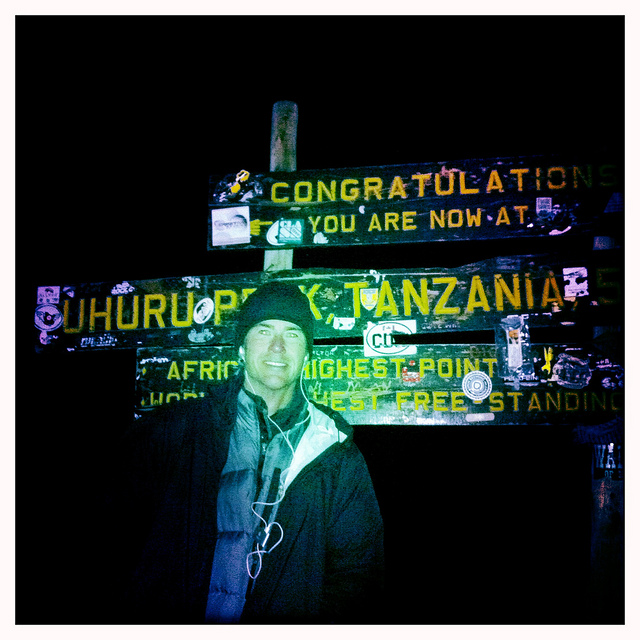
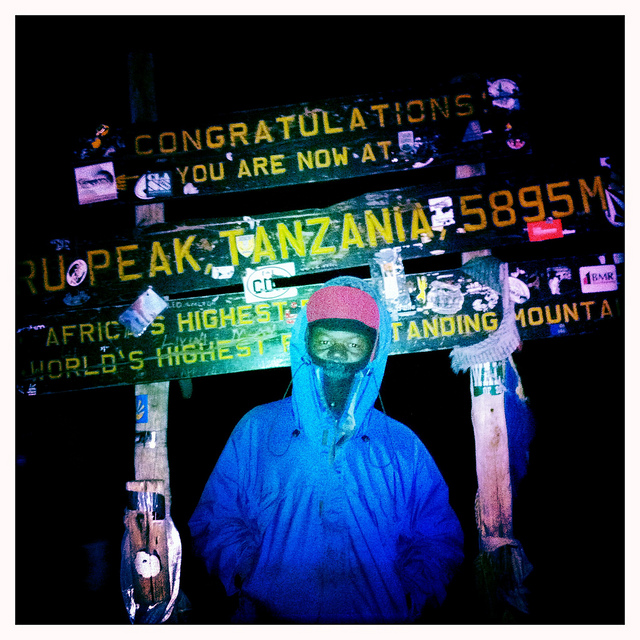
Signs of light appeared in the east as we hiked back to Gilman’s Point. Happy God raced ahead, but I walked slowly and took high-ISO landscape photos. I began to pass the main group of hikers on their way to Uhuru. Near Gilman’s Point I stopped until the sun rose and then followed Happy God back down to Kibo.
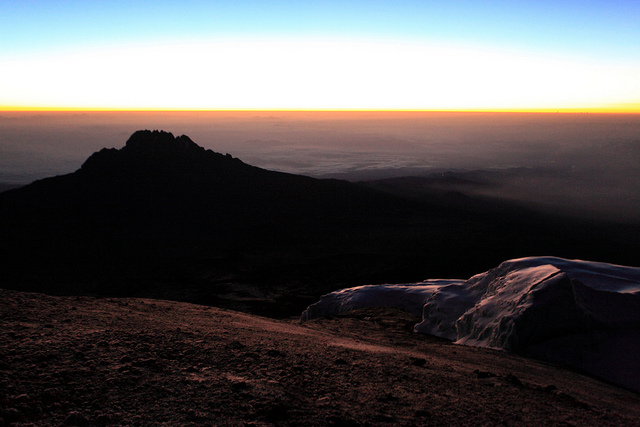
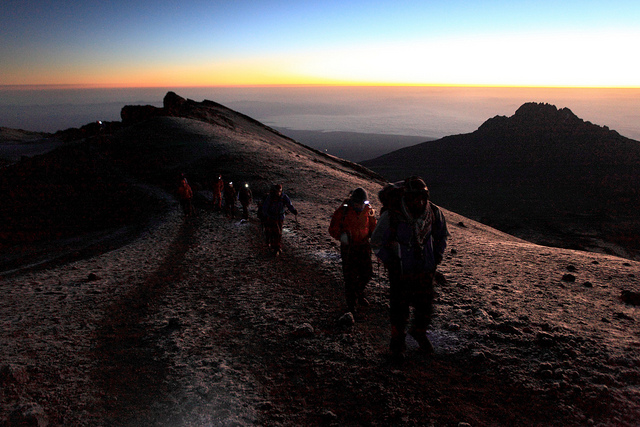
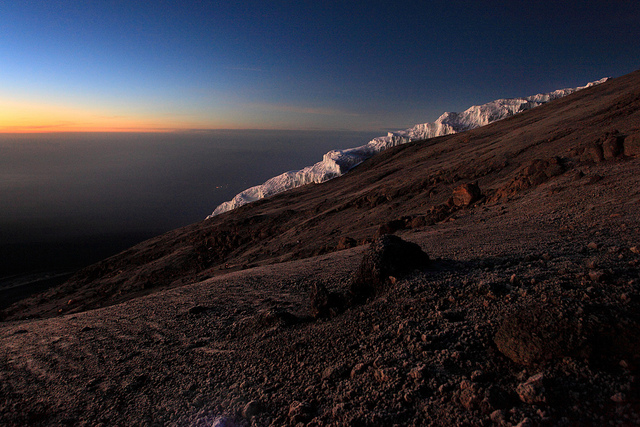
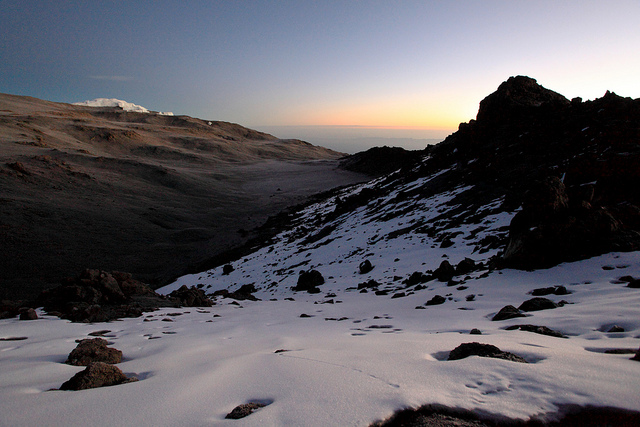
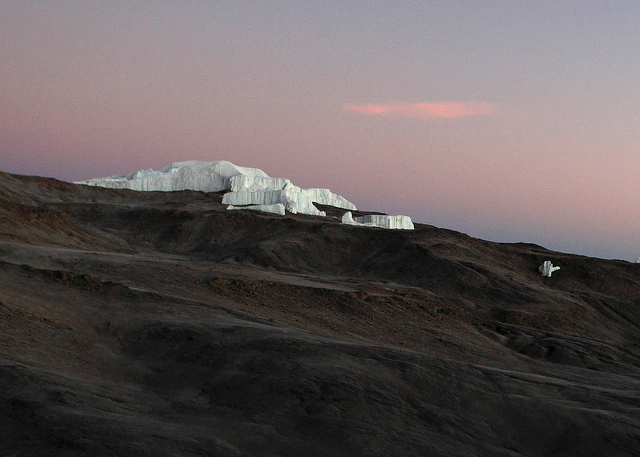
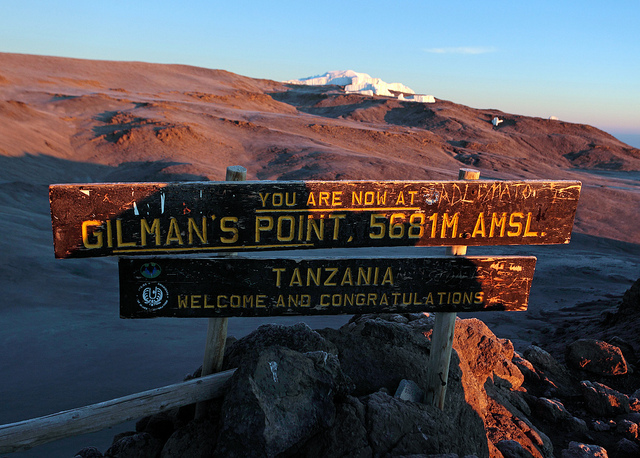
Going down was more difficult than I expected. Small, loose rocks covered the steep trail, making it easy to slip. The rocks were deep enough in one area that I could scree-slide, but otherwise I made slow progress and struggled to stay on my feet.
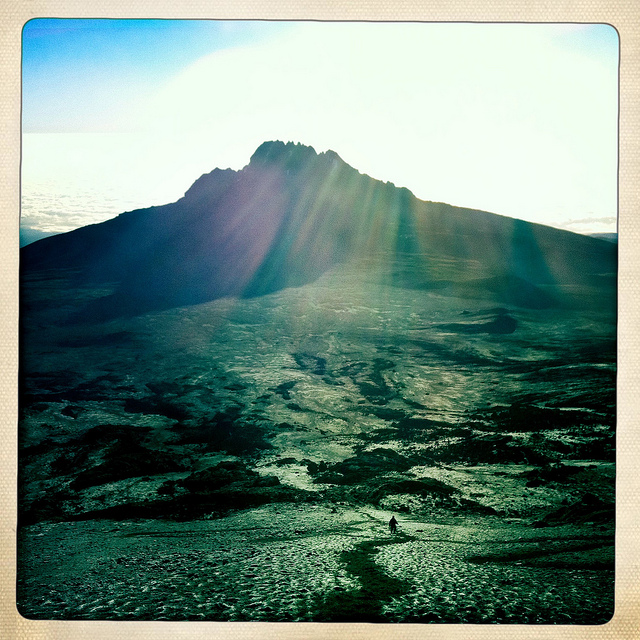
But we reached Horombo well before noon and the prospect of sitting idle for the rest of the day didn’t appeal to me. So after lunch at Horombo we hiked another two and a half hours to Mandara, where we spent our last night. We’d hiked almost 14 hours that day and after dinner I collapsed into my sleeping bag and didn’t move until the next morning.
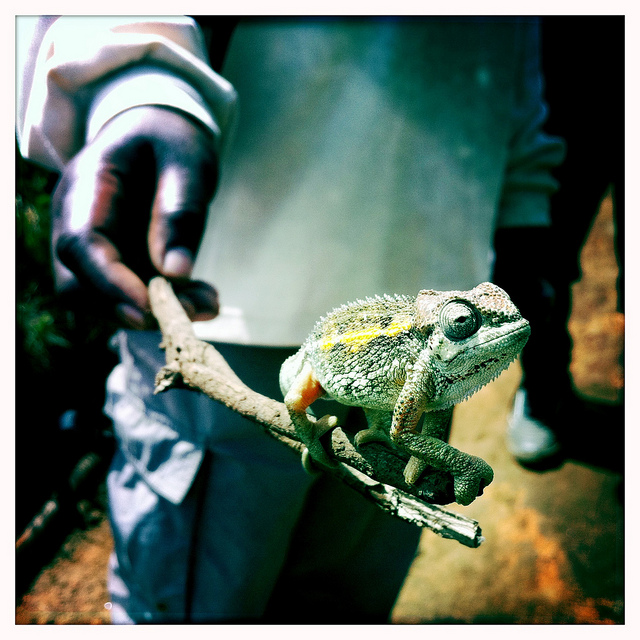
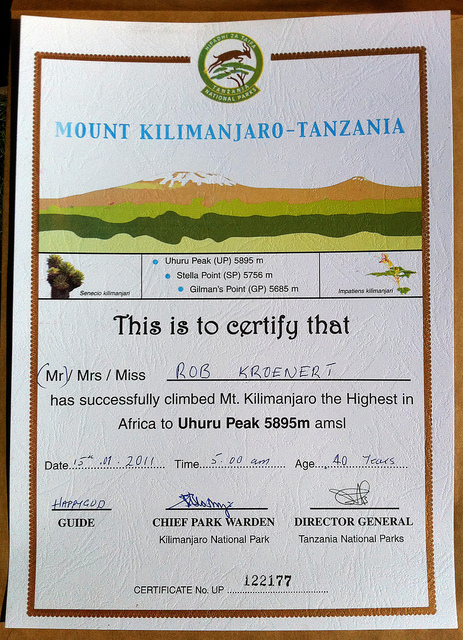
Happy God, Rama and I started early and practically jogged the rest of the way, pausing only to check out a chameleon on the trail. We reached Marangu in less than two hours. Back at the entrance gate I signed out and received an official certificate from Kilimanjaro National Park (suitable for framing, of course).


Look at you, baller! You could probably run an ultramarathon after that. Way to go — so glad you decided to do this.
How very nice to have the thought of Jake there with you, too.
LikeLike
Congratulation Rob, you have encouraged me, its my next plan to hike this mountain….it must be a sight to see.
Next time, try and stop over Kenya and hike Mt. Kenya, its spectacular.
Cheers!
Liz-From Masaai Mara Trip
LikeLike
Excellent description, making one feel a part of the expedition. I was in Marangu myself and went to the gate of the park as well but beyond that it was like a forbidden territory. Thanks for sharing.
LikeLike
I stumbled upon your blog when researching Kilimanjaro hikes… I actually am interested in getting in contact with Happy God. I am trying to find a reasonably inexpensive way to hike Kilimanjaro. If you could send me his information by email, that would be WONDERFUL! My name is Emma Weber and my email is emmayoder@gmail.com. Thank you in advance!
LikeLike