No place in Namibia interested me more than Sossusvlei. “One of the oldest and driest ecosystems on earth,” according to my guidebook. A place where towering red sand dunes rise up from the southern edge of the immense Namib Desert. Translations vary, but Sossusvlei means something along the lines of “a marsh where water goes and never returns.” As someone who loves photographing sand dunes, I’d come across striking images of Sossusvlei (and had been fascinated by them) long before I knew the name of the place or suspected I might actually have a chance to go there.
Three of the other tourists from my Etosha trip – everyone but Jean – had also signed up for Sossusvlei, and Marcus and Matthew were once again our guides. Julia, Edwin, Giacomo and I were joined by four new faces, all solo travelers: Annie, a middle-aged British woman; Juliane, a university student from Germany; Simone, a young Brazilian woman; and Markus (same name as our guide), a mid-20s German journalist who had just travelled overland all the way from Cairo to Cape Town.
We piled into our safari truck, a hulking, 17-seat Toyota Dyna, and began driving towards the desert. Very quickly the road changed from pavement to dirt. Namibia was still in the middle of its rainy season, and I’d heard that just a couple of weeks earlier the road to Sossusvlei was too muddy to use. But the tour operator had assured us that everything was now open.
Windhoek’s gently rolling green hills gave way to bleak, barren desert. Small but steep mountains jutted up dramatically from otherwise flat plains. For long stretches we saw no people, no buildings. Nothing but open space. Several different levels of clouds filled the sky, each moving in different directions and at different speeds. The ever-changing patterns, never the same but always variations on a consistent theme, dropped me into a daze in the same way as a campfire, or waves breaking on a beach.
An abrupt stop snapped me out of my reverie. I followed the others’ worried stares to the scene in front of us and immediately thought, “We’re going to be here for a while.” A stream flowed over a dip in the road, and just across it two vehicles – a bus and an SUV – were stuck side-by-side in deep mud. We got out for a closer look.
Trouble on the Road to Sossusvlei
The SUV belonged to a French husband and wife who were clearly overwhelmed. Guide Marcus (as opposed to Tourist Markus) offered to help. Realizing that in this situation one step forward required two steps back, Marcus was able to free the SUV from the mud by reversing it towards the stream. But, despite several attempts, he wasn’t able to coax the SUV up the incline. “Stop! You will break it!” yelled the wife, sounding slightly hysterical. Instead of thanking Marcus, the French couple scowled, turned their SUV around, and went back the way they’d come.
The departure of the SUV left enough room for our truck to pass. Marcus, Matthew, and driver of the bus agreed on a plan: get the truck across and then use it to tow the bus. We crossed our fingers as Marcus rolled the truck through the stream. We’d used rocks to build a path and Marcus hit exactly the right spot, but the mud was just too thick. Our truck became as badly stuck as the bus.
Our Safari Truck Stuck in the Mud
Marcus and Matthew never seemed the least bit discouraged. They spent the next half hour jacking up the back end of the truck and piling rocks underneath the tires. As they worked another SUV arrived on the scene and volunteered to help. The SUV had just enough power to pull our truck up the incline, and then the SUV and the truck towing simultaneously were able to free the bus. All things considered, I was impressed we only lost two hours. It could have been much worse.
Despite the delay we still made it to our campsite, right on the border of the Namib-Naukluft National Park, before dark. Guide Marcus took us straight to the nearby Elim dune and we climbed up to watch the sunset.
Juliane Jumping on the Elim Dune
Rainstorm Near Sossusvlei
Our group woke well before dawn the next morning so we could drive to the main dune field in time for sunrise. I eyed the cloudy sky, feeling anxious. This would be my one and only chance to photograph the heart of Sossusvlei. Without at least a little bit of direct light, my dune photos would be washed out and flat.
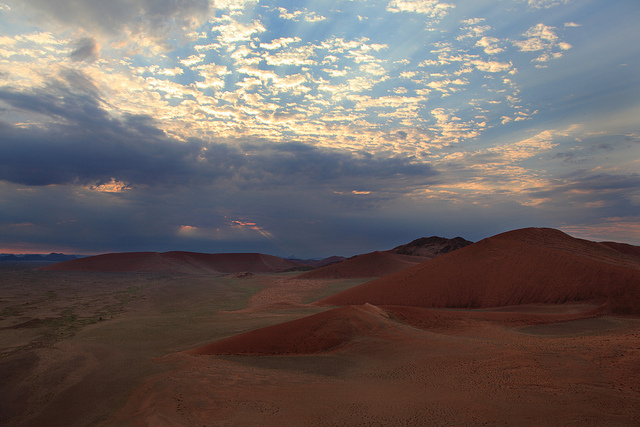
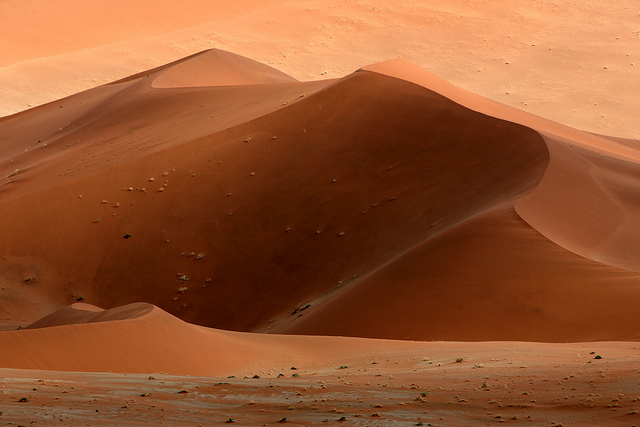
By 6:30am we were on top of Dune 45, named for its distance in kilometers from the park’s entry gate. It’s one of the few dunes in that part of the park that people are allowed to climb, and a couple of other tourist groups were already there when we arrived. Clouds continued to fill the sky, but every now and then a ray of soft morning sunlight broke through and selectively brightened one of the neighboring dunes. If I wasn’t quick I missed it.
Climbing Dune 45 before Sunrise
Pre-Dawn from Dune 45
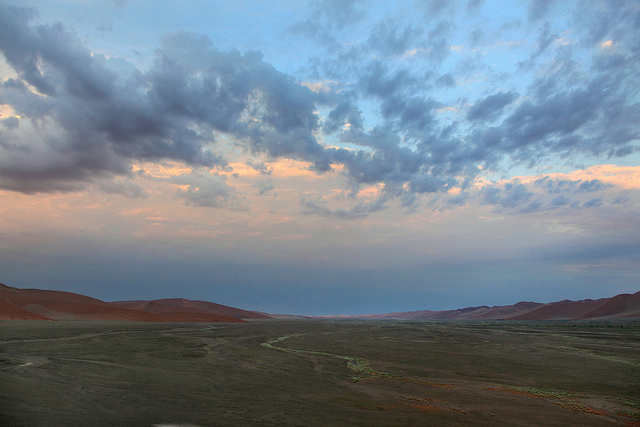
Dawn Clouds from Dune 45
Halfway Up Dune 45
Sunrise from Dune 45
Early Light on Sossusvlei Dune
Sossusvlei Sunrise Landscape
Our Group on Top of Dune 45
Sossusvlei Landscape
Annie on Dune 45
Simone on Dune 45
Tourists Climbing Dune 45
A picnic breakfast waited for us back at the truck. I paced restlessly as I ate, dropping my plate to take photos whenever a beam of the fickle morning light decided to streak over a dune.
Breakfast at Dune 45
Sossusvlei Dunefield
Brush, Tree, Dune, Mountain
Ostrich on the Move
Sossusvlei Sand Dune
After breakfast our group set out on a short hike. I still wanted direct light for my photographs, but, considering that I was already sweating in the shade at 9am, I wasn’t unappreciative of the patchy layer of clouds that shielded us from the full intensity of the desert sun. Guide Marcus led us over sand dunes, through mud fields that had been baked until they cracked into desiccated patterns, and past a rare pool of rainy-season floodwater.
Our Group in the Desert
Rare Floodwater in Sossusvlei
Selective Light on Sossusvlei Dunes
Running Down a Dune
Eventually we reached Dead Vlei, a desolately beautiful graveyard of ancient camel thorn trees that rise eerily from a yellowish-white clay pan. Circling the flat vlei are some of the tallest sand dunes in the world (including Big Daddy, which, at 325m, may be the world’s tallest, depending on which source you believe).
Camel Thorn Trees in Dead Vlei
Dead Vlei
Three Dead Camel Thorn Trees
Our Group Near Dead Vlei
A 4×4 gave us a ride back to our truck, stopping along the way at the Sossusvlei marsh that lends its name to the entire area. Over the course of the morning I’d had a chance to talk more with Tourist Markus, who, like Edwin, always had a smile on his face. Markus had spent the past eight months making his way from Cairo to Namibia, and in just a few weeks he needed to return to Egypt, where he was scheduled to take over as the Middle East correspondent for a German newspaper. Markus was initially upset about missing the recent drama in the Middle East and North Africa, but he said that until he took over from the current correspondent he wouldn’t play a significant role in the paper’s coverage anyway. The highlight of his trip had been a short excursion into the Congo, where he camped on the edge of an active volcano and watched orange magma bubbling into the air as night fell.
Markus and Marcus at Sossusvlei
That afternoon we visited the underwhelming Sesriem Canyon. “Who can throw a rock the most far?” Giacomo asked me. I made the mistake of accepting his challenge and lost badly when he launched one all the way to the other side of the canyon.
A light rain that had been threatening for hours finally began to fall, and most of us were ready to agree with Guide Marcus’ suggestion that we just head back to camp, eat dinner, and call it a night. Thankfully, Tourist Markus reminded us that we didn’t exactly find ourselves in Sossusvlei, Namibia, every day, and we should make the most of it. The four ladies, not persuaded, returned to their tents, but Tourist Markus, Giacomo, Edwin and I asked to be dropped off at the Elim dune.
As soon as we arrived at Elim the rain stopped. Edwin spotted a rainbow on the eastern horizon. “Oh my God!” he yelled with characteristic enthusiasm. “Wunderbar!” We climbed up the dune in the warm yellow glow of the late evening light and were rewarded with a beautiful sunset.
Sossusvlei Rainbow
View from Elim Dune Just before Sunset
Sunset from the Elim Dune
Landscape from Elim Dune
Sunset Color from Elim Dune
Once again I shared a tent with Giacomo. “You want to know something?” he asked as I tried to fall asleep that night. “In the country Scotland, sheeps, they are on a hill, and one sheep it fall and roll down the hill. All other sheeps see that it is faster to roll, so they fall and roll also. Then, after passes one week, sheeps in the country Australia, they also fall and roll. Do you know this?”
On our way back to Windhoek the next morning we made a brief stop at the desert town of Solitaire, where – even though the population numbers no more than 100 souls – you can find a German bakery that sells apple strudel.
Old Abandoned Car in Solitaire
I once heard an art history professor say that landscapes symbolize states of mind. A beautiful sunrise on a spring day, for example, might suggest feelings of hope and renewal. A stormy ocean might represent inner turmoil.
What does it mean, then, when we feel strongly drawn to a certain kind of landscape? The easiest explanation would be that a desire for harmony simply pushes us towards landscapes that match our state of mind. But it seems like the opposite might be just as true – a need for balance could attract us to landscapes that provide some kind of mirror-image compensation for whatever we have in our heads. Or maybe a sense of aspiration is sometimes the driving force, causing us to subconsciously seek out landscapes that represent a state of mind we hope to have in the future.
Superb photography. I've been there, spent 3 nights there to try get the light while in different spots in each of the 3 morning, and still got nothing like your images.







Fantastic, incredible shots in spite of the light issue you had to put up with! I definitively want to try to go there now 🙂
LikeLike
just incredible !!!
LikeLike
Superb photography. I've been there, spent 3 nights there to try get the light while in different spots in each of the 3 morning, and still got nothing like your images.
Well done!
Merv.
LikeLike
wow! looks gorgeous! gonna put this in my bucket list. 🙂
LikeLike
Your photos are amazing! I head to Windhoek tomorrow and out to the dunes on Tuesday – I can't wait! Hope I get even one photo as good as yours!
LikeLike